“Again?”
“Yes. Just one more time.”
A child once looked at me as if I had asked for something terribly unfair.
They had already read the sentence.
Why would they need to read it again?
So I pointed to the sentence.
The green boat is on the sea.
The first time, it sounded like this :
“The…green…boat…is…on…the…sea.”
Every word was correct.
We read it again.
This time, there were fewer pauses.
Then I said :
“Once last time. Don’t try to read faster. Just make it sound like you’re telling me something.”
The child tried again.
“The green boat is on the sea.”
Then came a little smile.
They could hear the difference too.
And that is one of my favourite moments in teaching reading.
Not because the child suddenly became a fast reader.
But because, for a moment, they stopped sounding like someone who was working out a sentence and started sounding like someone who was reading one.
That small change is where today’s lesson begins.
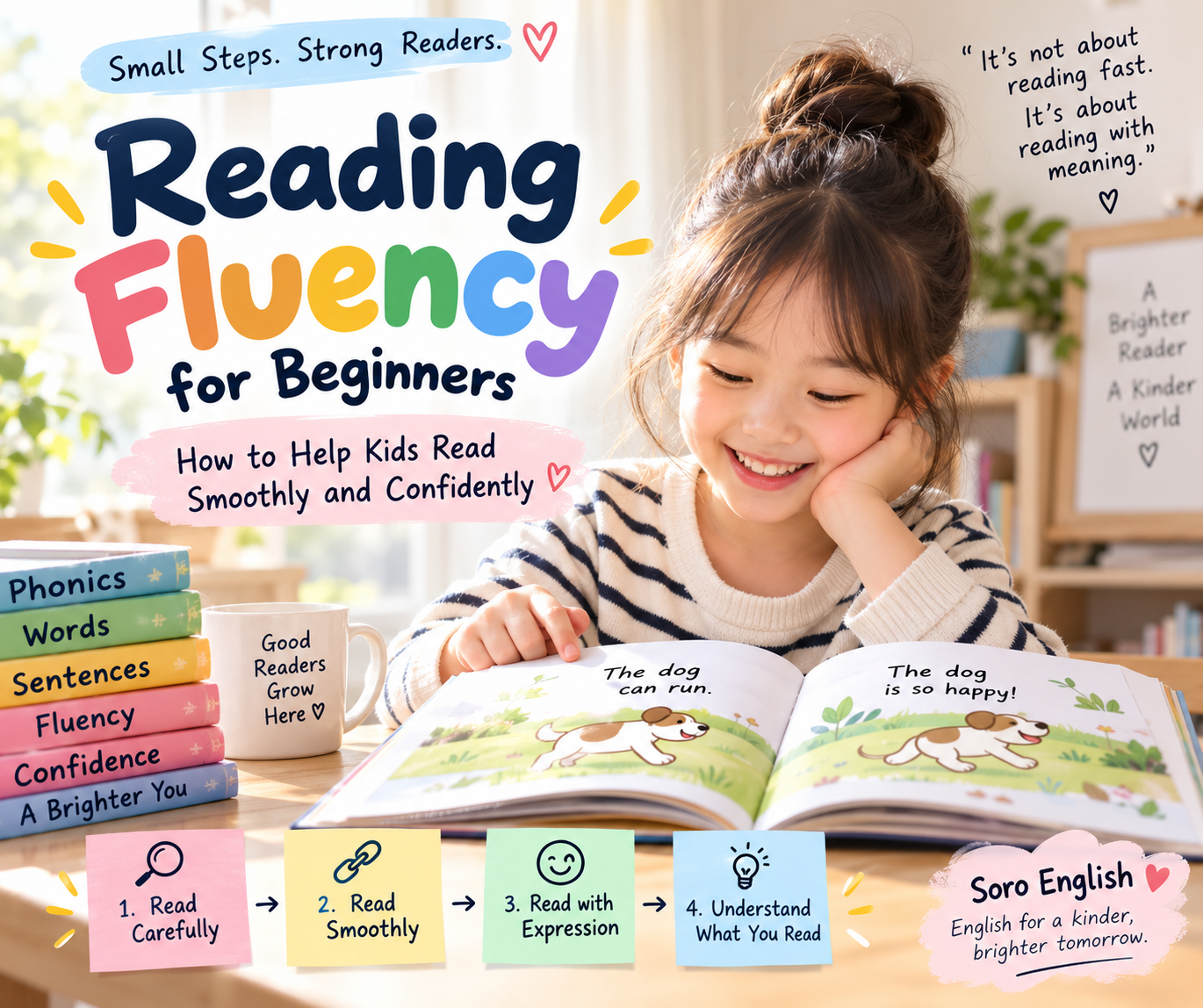
Reading fluency.
Fluent Reading Is Not fast Reading
When parents hear the word fluency, it’s easy to think of speed.
How many words can my child read in a minute?
Why does my child read more slowly than other children?
Should I make them practise faster?
But when I work with a beginning reader, speed isn’t the first thing I’m listening for.
I’m listening for a something else.
Can the child read the words accurately?
Can they put words together instead of stopping after every one?
Does a question sound like a question?
And most importantly :
Do they understand what they just read?
That’s why my definition of reading fluency for beginners is simple :
Read it right. Read it smoothly. Understand what you read.
Speed can develop as reading becomes easier.
It doesn’t need to be the starting line.
The Moment Phonics Starts Becoming Reading
Think about everything a beginning reader has already learned.
They may have started with individual letter sounds.
Then came :
cat
and pig.
Later :
frog
ship
cake
rain
boat
Each new phonics pattern gave them another tool for figuring out unfamiliar words.
But there’s a difference between being able to decode :
boat
and comfortably reading :
The little boat is floating on the sea.
That’s the bridge we’re trying to cross now.
Until this point, much of our Soro English journey has been about :
“How can I read this word?”
Now we’re beginning to ask :
“How can I read this sentence so it makes sense?”
And I think that’s a very exciting shift for a young reader.
Why Can My Child Read the Words but Not the Sentence?
This is a very common stage.
Imagine how much work is happening inside a beginning reader’s head.
They see :
boat
Then they have to recognise:
b + oa + t
They remember the sound represented by oa.
They blend the sounds.
Finally :
boat!
Now imagine doing that for almost every word in a sentence.
Of course the reading sounds slow.
The child’s brain is working hard.
That’s why I don’t immediately say :
“Read faster.”
Instead, I ask :
“Which part is still taking a lot of effort?”
Sometimes the child needs more phonics practice.
Sometimes they need to see familiar words more often.
And sometimes they simply need to read the same short sentence again.
Accuracy Comes Before Speed
This is one of the most important rules in my reading lessons.
Accuracy first. Speed later.
Suppose a child reads :
The goat is on the road.
as :
“The got is on the rod.”
Reading it faster isn’t going to solve the problem.
We need to return to the words.
Look at :
goat
Find :
oa
Blend :
g – oa – t
goat
Then :
road
r-oa-d
road
Once the words are accurate, we can work on making the sentence smoother.
I would much rather hear a child read slowly and correctly than quickly and inaccurately.
Don’t Tell a Beginning Reader to “Read Faster”
“Read faster!”
It’s an easy thing to say.
But what is a child supposed to do with that instruction?
Instead, try :
“Let’s read that sentence one more time.”
Or :
“This time, let’s put these words together.”
Or :
“Can you make it sound like you’re talking?”
These instructions give the child something concrete to try.
The goal isn’t speed for its own sake.
The goal is to make reading require a little less effort each time.
Step 1: Start with Words the Child Can Actually Read
Fluency practice shouldn’t feel like a decoding test filled with unfamiliar patterns.
If your child has recently learned ai, ay, ee, ea, oa and ow, use sentences containing familiar vowel-term words.
For example :
It may rain.
We can play.
I see a green tree.
The goat is on the road.
The boat is on the sea.
We play in the snow.
The child already knows the target phonics patterns.
Now we’re asking them to use that knowledge in connected reading.
This is why I like building reading instruction step by step.
One lesson should make the next lesson easier.
Step 2: Try Repeated Reading
One of the simplest fluency activities requires no special materials.
Read the same sentence more than once.
Try :
First Read
The goat is on the road.
Let your child work it out.
Don’t worry if it’s slow.
Second Read
Read it again.
Third Read
Ask :
“Can you make it sound smooth this time?”
Often the third reading sounds very different from the first.
Why?
The child isn’t solving every word from the beginning anymore.
Some of the work has already been done.
The Three-Read Challenge
I like turning repeated reading into a tiny challenge.
Not a speed contest.
A smooth – reading challenge.
Read 1 – Be a Word Detective 🔎
Read every word carefully.
Read 2 – Put the Words Together 🔗
Try not to stop after every word.
Read 3 – Make It Sound Like Talking 💬
Read the sentence naturally.
Try it with:
It may rain today.
☐ Read 1
☐ Read 2
☐ Read 3
Then ask :
“Which reading sounded the smoothest?”
Let the child decide.
That little bit of self-evaluation is useful.
Step 3 : Teach Children to Read in Phrases
Sometimes a child knows every word but still pauses after each one.
Try making phrases.
Instead of:
The / little / goat / is / on / the / road.
Show :
The little goat /is on the road.
Or :
After the rain / we went outside to play.
You can draw a small curved line under words that belong together.
Then read each phrase.
The little goat
is on the road.
Finally, put them together.
The little goat is on the road.
Now the sentence begins to sound like language rather than a list of words.
Step 4 : Let Your Child Hear Fluent Reading
Before asking a child to read smoothly, let them hear what smooth reading sounds like.
Take :
The boat is on the sea.
First, you read it naturally.
Then say :
“Your turn.”
This is sometimes called echo reading.
Parent :
The boat is on the sea.
Child :
The boat is on the sea.
Then try a slightly longer sentence.
Parent :
The green boat is on the sea.
Child :
The green boat is on the sea.
It’s simple, but very useful for children who don’t yet know how expression and phrasing should sound.
Step 5 : Read Together
Another activity I use is reading the sentence together.
You don’t read first.
You both read at the same time.
We can play in the snow.
This takes some pressure off the child.
After reading together once or twice, say :
“Now you try.”
For a child who feels nervous about reading aloud, this can make practice feel much safer and more manageable.
Step 6 : Make Punctuation Mean Something
Beginning readers sometimes treat punctuation as decoration.
Show :
It is snowing.
Then:
Is it snowing?
And :
Look at the snow!
Ask:
“Should all three sentences sound the same?”
Reading them together.
A period tells us the thought has ended.
A question mark changes how the sentence sounds.
An exclamation mark can add excitement or strong feeling.
This is where reading begins to sound alive.
Try the “Robot or Reader?” Game
This is one of my favourite ways to explain fluency to children.
Say :
“I’m going to read this like a robot.”
I. CAN. SEE. A. GREEN. TREE.
Make it deliberately robotic.
Children usually laugh.
Then say :
“Now I’ll read it like a reader.”
I can see a green tree.
Ask :
“Which one sounded better?”
Then let the child try both.
🤖 Robot Voice
The. Goat. Is. On. The. Road.
📖 Reader Voice
The goat is on the road.
Children can often hear fluency before they can explain it.
A Simple 10 – Minute Reading Fluency Routine
You don’t need a 30-minute fluency lesson.
Try this.
Minutes 1-2: Warm Up
Read five familiar words.
rain
play
green
boat
snow
Minutes 3-4: Read One Sentence
The green boat is on the sea.
Help with any difficult words.
Minutes 5-6: Read It Again
Read the same sentence more smoothly.
Minutes 7-8: Read Two More Sentences
It may rain today.
We can play in the snow.
Minutes 9-10: Finish With a Tiny Passage
Read three or four connected sentences.
Then stop.
Ten successful minutes are enough.
I would rather finish while a child still feels :
“I can do this.”
than continue until reading becomes a battle.
Reading Fluency Practice Sentences for Beginners
Try these at home.
Level 1
I can see a bee.
It may rain.
We can play.
The goat can run.
Level 2
The bee is in the tree.
The goat is on the road.
We can play in the rain.
The boat is on the sea.
The green plant will grow.
Level 3
The little goat walks down the road.
We stay inside when it starts to rain.
I can see a green tree by the sea.
The boat moves slowly across the water.
Don’t rush through all three levels.
Start where your child can succeed.
Reading Fluency Passage 1: A Rainy Day
Read 1 – Carefully
Read 2 – Smoothly
Read 3 – With Expression
A Rainy Day
It may rain today.
Jay looks at the gray sky.
He wants to go out and play.
Soon,the rain stops.
Jay puts on his coat.
He goes outside.
“What a great day!” says Jay.
Think About it.
- What is the weather like at first?
- What does Jay want to do?
- What happens to the rain?
- What does Jay do at the end?
Notice what we’re doing here.
We’re not practising fluency in isolation.
We’re still checking :
Did the child understand what they read?
Because smooth reading without understanding isn’t the final goal.
Reading Fluency Passage 2: The Goat
The Goat on the Road
Lee sees a Goat.
The goat is by the road.
“Come here, little goat” says Lee.
The goat looks at Lee.
Then it slowly walks away.
Lee smiles.
“Goodbye, goat!”
Read It Three Times
ㅁ I read carefully.
ㅁ I read smoothly.
ㅁ I used expression.
Quick Check
Who sees the goat?
Where is the goat?
What does the goat do?
What If My Child Keeps Stopping at Every Word?
First, find out why.
Can the child actually decode the words?
If not, return to the phonics pattern causing difficulty.
If they can read the individual words but pause after every one, try.
echo reading
reading together
phrase marking
and repeated reading
Don’t try to fix everything in one lesson.
Choose one short sentence.
Make that sentence successful.
Then move on.
What If My Child Makes a Mistake?
I don’t immediately give the answer.
Suppose the word is :
boat
and the child gets stuck.
I might point to :
oa
and ask :
“What vowel team do you see?”
Then :
“Try the word again.”
This reminds the child to use the letters rather than wait for an adult to supply the word.
I want children to gradually develop their own question :
“What can I try?”
That’s the kind of independence we’re working toward.
Should I Time My Child’s Reading?
Parents often ask this.
Timing can be useful in some structured assessments or instructional settings.
But for everyday beginner practice at home, I wouldn’t make the stopwatch the centre of the lesson.
If a child starts thinking :
“I have to beat my time.”
They may begin skipping words, guessing or ignoring punctuation.
Instead, listen for improvement.
Was the second reading more accurate?
Were there fewer long pauses?
Did the child group words together?
Did the question sound like a question?
Did they understand the passage?
Those are meaningful signs of progress too.
Fluency Is Not Memorising the Passage
There’s another trap with repeated reading.
After several readings, a child may remember the sentence.
That’s not necessarily bad.
Familiarity is part of learning.
But we also need to know whether the child can transfer the skill to new text.
So after practising :
The goat is on the road.
Try :
The boat is on the sea.
Then :
The green goat walks down the road.
Same familiar patterns.
New reading.
That’s where we begin to see whether the skill is becoming flexible.
Fluency and Comprehension Belong Together
This matters to me as a teacher.
I don’t want children to become excellent word callers.
After a child reads :
The bee is in the green tree.
ask :
“Where is the bee?”
After :
Jay plays outside when the rain stops.
ask :
“When does Jay go outside?”
One simple question is enough.
The message is :
We read words because they mean something.
5 Reading Fluency Activities You Can Do at Home
You don’t need expensive materials.
Try rotating these activities.
- Echo Reading – You read. Your child repeats.
- Read Together – Read the same sentence at the same time.
- Three-Read Challenge – Careful ➡️ Smooth ➡️ Expressive
- Robot or Reader? – Compare choppy and natural reading.
- Phrase Reading – Group words that belong together.
You can do all five with the same short passage.
That’s one reason fluency practice can be surprisingly simple.
Free Reading Fluency Worksheets for Beginners
To make practice easier, I’ve created reading fluency activities that beginning readers can use at home.
The printable practice can include :
Three – Read Challenge
Robot or Reader?
Phrase Reading
Read and Draw
Vowel Team Fluency Sentences
Short Reading Passages
Read and Answer
Fluency Progress Tracker
Parent Reading Guide
Reading Star Certificate
Use one or two pages at a time.
You don’t need to finish the whole pack in one sitting.
A little reading every day can go a long way.
Frequently Asked Questions About Reading Fluency
What is reading fluency for beginners?
Reading fluency means gradually learning to read accurately, smoothly and with appropriate expression while understanding the text.
How can I help my child read more fluently?
Start with text your child can decode. Try repeated reading, echo reading, reading together and short phrase-reading activities.
Should beginning readers read fast?
Speed shouldn’t be the first goal. Accuracy and understanding come first. As reading becomes more automatic, an appropriate pace can develop naturally.
How many times should my child reread a passage?
There isn’t a magic number. Two or three purposeful readings of a short passage can be enough for beginner practice. Stop if rereading becomes frustrating or meaningless.
How long should we practise reading fluency?
For many young beginning readers, a short daily session can be more manageable than a long lesson. Even around 10 minutes of focused practice can provide useful repetition.
What if my child still struggles with individual words?
Return to decoding. Review the relevant letter-sound or phonics pattern before expecting smooth passage reading.
Does fluency matter if my child understands phonics?
Yes. Phonics gives children tools for decoding words. Fluency helps them use those skills efficiently in connected text, while comprehension keeps the focus on meaning.
What Comes After Reading Fluency?
We’ve travelled along way together.
Letter Sounds
⬇️
Short Vowels
⬇️
CVC Words
⬇️
Word Families
⬇️
Consonant Blends
⬇️
Digraphs
⬇️
Silent E
⬇️
Vowel Teams
⬇️
Reading Fluency
And now something exciting happens.
We can start spending more time on real connected reading.
The next Soro English lesson will be :
Decodable Reading Passage for Beginners : From Phonics Words to Real Reading.
We’ll practise familiar phonics patterns inside short, manageable passage and help children move from :
“I can read this word.”
to
“I can read this story.”
Final Thoughts
When a child reads :
“The…goat…is…on…the…road.”
It’s tempting to finish the sentence for them.
Or say :
“Come on,you know this. Read faster.”
But I try to remember what that pause means.
The child is thinking.
They’re looking at the letters.
They’re retrieving sounds.
They’re blending.
They’re trying to make meaning from marks on a page.
That’s a lot of work.
So instead of asking :
“Why are you reading so slowly?”
I prefer :
“Let’s try it one more time.”
The first reading might be difficult.
The second might be a little easier.
And on the third :
“The goat is on the road.”
Suddenly, it sounded like a sentence.
The child hears it too.
And that tiny moment matters.
Because reading fluency isn’t about winning a race through a page.
It’s about reaching the point where the words require a little less effort, so the child has more attention left for the story, the idea and the joy of understanding what they just read.
That’s the reader I want to help build at Soro English.
Small steps. Strong readers.
-Soro English