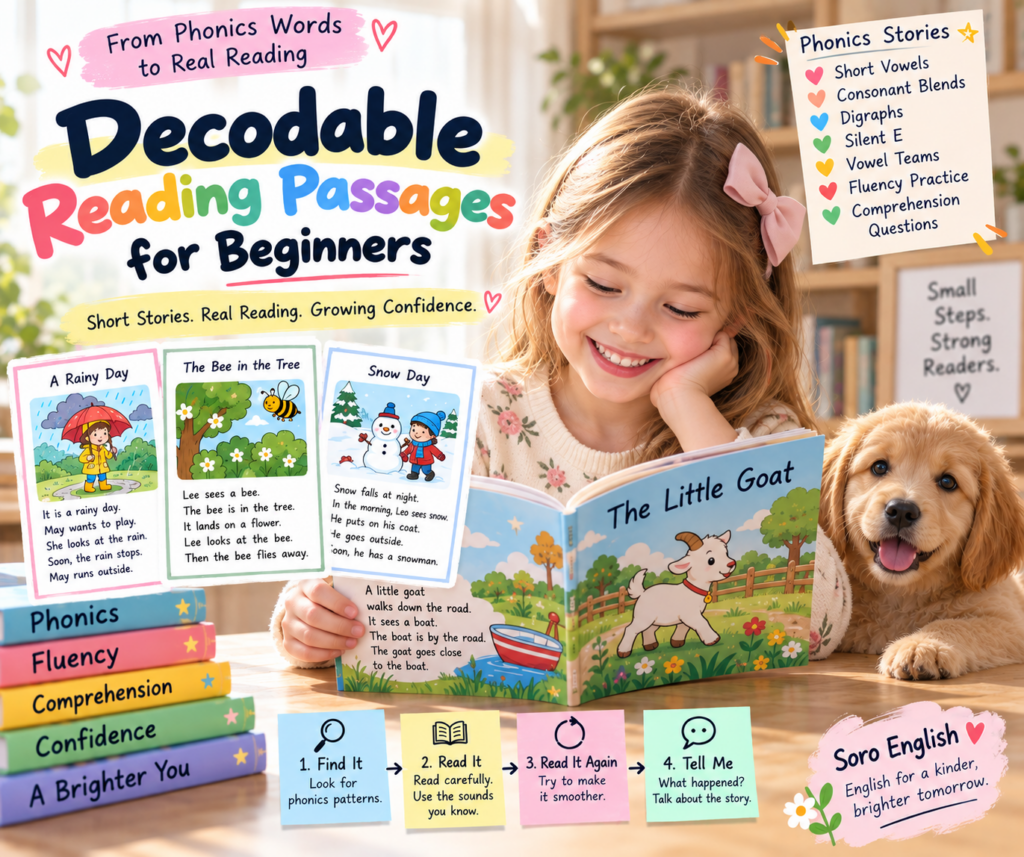
I sometimes close the book.
Not because the lesson is over.
Actually, that’s when one of my favorite parts begins.
I ask :
“So… what happened?”
Silence.
The child looks at me.
Then at the book.
Then back at me.
“Can I look again?”
Of course.
They open the book and search for the answer.
Sometimes they can read every sentence beautifully.
They know the phonics patterns.
They don’t stumble over many words.
Their reading even sounds smooth.
But when I ask what happened in the story…
They aren’t quite sure.
And that’s when I remember something important:
Reading the words and understanding the words are not exactly the same thing.
Learning to decode is a huge achievement.
But decoding isn’t the finish line.
Eventually, we want a child to close the book and have something left in their mind:
a character,
an event,
a funny moment,
a question,
an idea.
That’t where reading comprehension begins.
And the good news?
We don’t need to turn every story into a test to teach it.
What Is Reading Comprehension?
Reading comprehension simply means understanding what we read.
For a beginning reader, that might mean begin able to answer:
Who was in the story?
Where were they?
What happened?
Or perhaps:
Why was the boy happy?
But I think there’s an even simpler way to check.
After reading a short story, ask:
“Can you tell me about it?”
Imagine a child reads:
Ben has a red kite.
He takes it to the park.
The wind blows.
The kite goes up.
Ben smiles.
Then you close the page.
“What happened?”
If the child says:
“Ben flew his kite at the park.”
Wonderful.
They didn’t repeat the passage word for word.
They did something more important.
They understood it.
Reading Comprehension Starts Before the Questions
One mistake I try to avoid is thinking:
Comprehension = worksheet questions.
A child reads six sentences.
Then answers five questions.
Done.
But comprehension is happening while the child reads, not only afterward.
Take:
Mia put on her boots and took her unbrella.
Before reading another sentence, I might ask:
“Hmm… what do you think the weather is like?”
The child may say:
“Rainy!”
Now they’re doing more than decoding.
They’re connecting clues.
They’re thinking.
They’re building meaning.
That’s the habit I want.
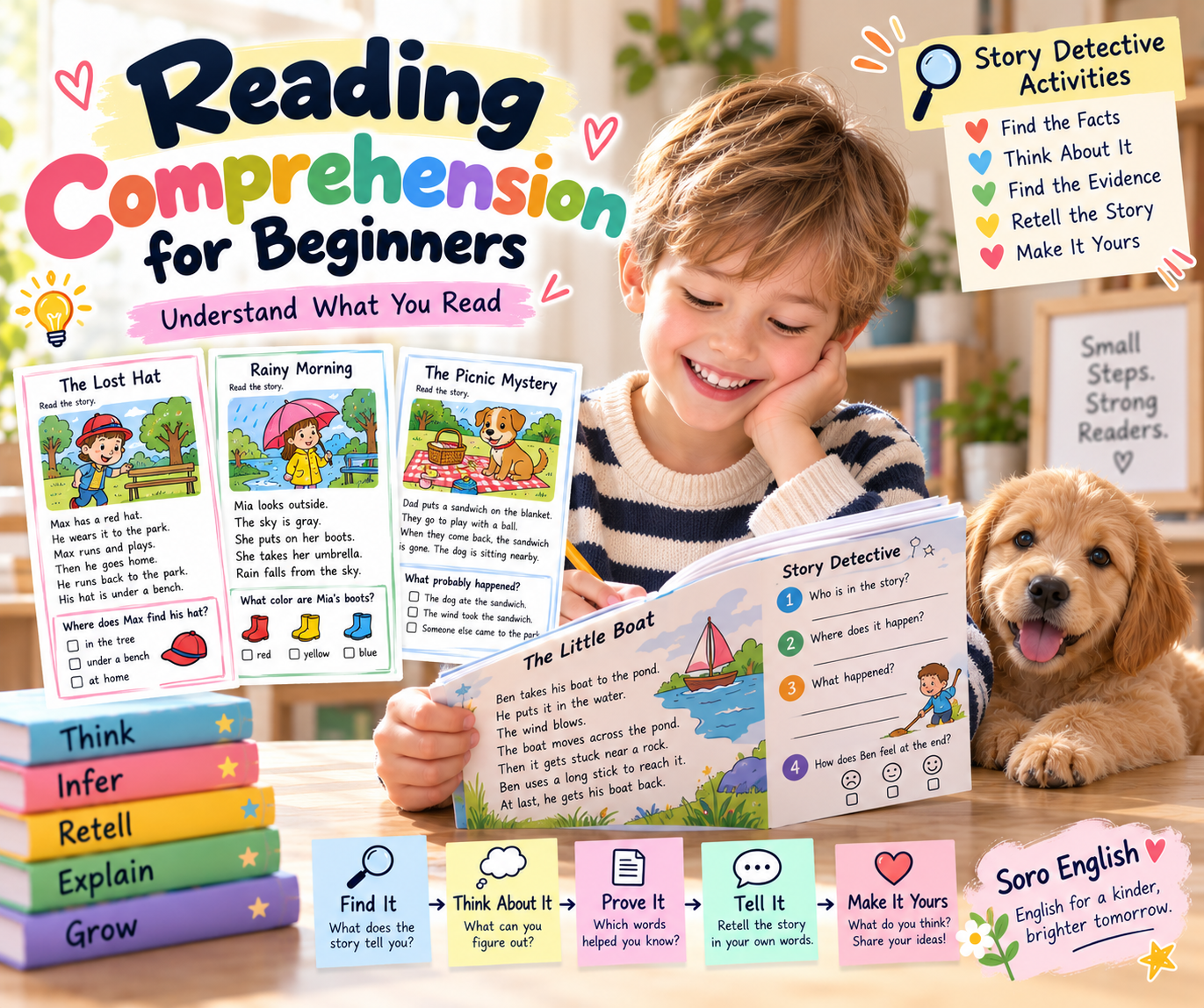
The Soro English “Story Detective” Routine🔎
We’ve already used familiar routines throughout our phonics and fluency lessons.
For reading comprehension, I like another simple routine:
WHO → WHERE →WHAT →HAPPENED →WHY?
I call it:
The Story Detective🔎
Beginning readers don’t need complicated literary terminology.
They need a few questions they can carry from story to story.
🔎 Clue 1: WHO?
Who is the story about?
Sam has a little dog.
Who?
Sam and his dog.
📍 Clue 2: WHERE?
Where does the story happen?
Sam takes his dog to the park.
Where?
At the park.
➡️ Clue 3: WHAT HAPPENED?
What happened in the story?
The dog sees a ball.
He runs after it.
What happened?
The dog ran after a ball.
💭 Clue 4: WHY?
Why did something happen?
The dog runs to Sam because Sam has a treat.
Why did the dog run to Sam?
Because Sam had a treat.
That’s already meaningful comprehension practice.
No complicated terminology required.
Start With “Right There” Questions
For a child who has just begun reading short passage, I don’t start with difficult inference questions.
I begin with answers that can be found directly in the text.
Read:
Ava has a yellow bag.
She puts a book in the bag.
Ask:
What color is Ava’s bag?
What does she put inside?
The child can go back and fine the answer.
This teaches another important reading habit.
Good readers go back to the text.
Not remembering everything isn’t failure.
Knowing where to look is a reading skill too.
Try This: “Show Me Your Proof”
Here’s one of my favorite comprehension activities.
Instead of asking only:
“What’s the answer?”
ask:
“Show me the words that helped you.”
For example:
Leo puts on his coat. Snow falls outside.
Question:
What is the weather like?
Child:
“Snowy.”
Then ask:
“Show me your proof.”
The child points to:
Snow falls outside.
Now the child isn’t simply guessing an answer.
They’re learning to connect an answer to evidence in the text.
For older children, we may eventually call this text evidence.
For beginners, I simply call it:
🔎 Find the clue.
Reading Comprehension Passage 1: The Lost Hat
📖 Read
The Lost Hat
Mix has a red hat.
He wants it to the park.
Max runs and plays.
Then he goes home.
“Where is my hat?”he asks.
Max runs back to the park.
His hat is under a bench.
“There it is!”
Max puts on his hat and smiles.
🔎 Become a Story Detective
WHO?
Who is the story about?
WHERE?
Where does Max go?
WHAT HAPPENED?
What did Max lose?
WHY?
Why does Max go back to the park?
⭐ Show Me Your Proof
Underline the sentence that tells you where Max finds his hat.
Don’t Ask Questions After Every Sentence
This is another habit I try to avoid.
Imagine trying to enjoy a story like this:
“The little dog ran -”
“WHO RAN?”
“The dog ran to the gate-”
“WHERE DID HE RUN?
“He saw his friend-”
“WHO DID HIS SEE?”
By the end, the child may remember the questions better than the story.
Sometimes it’s better to let the story breathe.
Read a small section.
Pause.
Think.
Continue.
Then talk.
Reading comprehension should help children enter the story – not keep pulling them out of it.
Try “Stop, Think, Read on”
This is a simple strategy parents can use without any worksheets.
STOP ✋
Pause after an interesting sentence.
THINK 💭
Ask yourself:
“What do I know so far?”
READ ON 📖
Keep reading to see what happens.
For example:
Lily looks outside. Dark clouds fill the sky.
STOP.
“What do you think might happen?”
“It might rain.”
First, _________________.
READ ON.
Soon, rain taps on the window.
“Were we right?”
Yes!
Prediction doesn’t need to complicated.
It’s simply teaching children to think between sentences.
Reading Comprehension Passage 2: Rainy Morning
Rainy Morning
Mia wakes up.
She looks out the window.
The sky is gray.
Mia puts on her yellow boots.
She takes her umbrella.
“Don’t forget your coat!” says Dad.
Mia opens the door.
Rain falls from the sky.
“Good thing I have my umbrella!”she says.
🔎 Find the Facts
- What color is the sky?
- What color are Mia’s boots?
- What does Dad tell Mia to take?
💭 Think a Little Deeper
4. Why does Mia take an umbrella?
🔍 Show Your Proof
Which words tell you that the weather is rainy?
Underline them.
Literal Questions vs. Thinking Questions
Once children are comfortable finding information directly in the text, we can add questions that require a little more thinking.
Consider:
Jake’s hands are full. He stands in front of the door. Mia gets up and opens it for him.
Right – There Question
Who opens the door?
Answer: Mia
It’s stated directly.
Thinking Question
Why does Mia open the door for Jake?
The text doesn’t say:
“Mia opened the door because Jake couldn’t easily open it.”
The child has to connect:
Jake’s hands are full
●
Mia opens the door
to infer the reason.
That’s an important step in comprehension.
Teach Children to Say “Because…”
This tiny word can do a lot.
Instead of accepting:
“He’s sad.”
try:
“Why do you think he’s sad?”
Then encourage:
“I think he’s sad because…”
For example:
Tom looks in his lunch box. It is empty. He frowns.
“How does Tom feel?”
“Sad.”
“How do you know?”
“I think Tom is sad because his lunch box is empty and he frowns.”
Now we’re moving beyond identifying an answer.
We’re explaining our thinking.
Reading Comprehension Passage 3: The Empty Box
The Empty Box
Ella sees a big box.
“What is inside?” she wonders.
She lifts the box.
It feels very light.
Ella shakes it.
She hears nothing.
She opens the box.
Nothing is inside.
Ella laughs.
“It was just an empty box!”
Find It
- What does Ella find?
- Is the box heavy or light?
Think
3. Before Ella opens the box, what do you think she expects?
4. How does Ella feel at the end?
Prove It 🔎
Which word gives you a clue about Ella’s feeling?
Picture Are for Thinking, Not Guessing Words
In our decodable reading lessons, we talked about using letters rather than relying on pictures to guess unfamiliar words.
But pictures still have an important job.
They can help children think about meaning.
After the sentence has been read, look at the illustration.
Ask:
“What else do you notice?”
“How does the character look?”
“Does the picture give us another clue?”
That’s different from:
“Look at the picture and guess the word.”
For Soro English, I like to keep the distinction simple:
Letters help us decode.
Pictures can help us explore meaning.
Reading Comprehension Passage 4: The Little Goat
The Little Goat
A little goat stands by a fence.
It looks at the green grass on the other side.
The goat pushes the fence.
It pushes again.
The fence does not move.
Then Joan comes with some grass.
The goat runs to Joan.
“Were you hungry?” she asks.
The goat eats the grass.
Story Detective 🔎
WHO?
WHERE?
WHAT DOES THE GOAT WANT?
WHAT HAPPENS AT THE END?
Think
Why was the goat pushing the fence?
Find Your Evidence
Which part of the story helped you answer?
Sequencing: What Happened First?
Understanding a story also means understanding order.
Try this after a short passage:
FIRST
What happened first?
NEXT
What happened next?
THEN
What changed?
LAST
How did the story end?
I often prefer this to asking children to memorize every little detail.
If they can explain the important events in order, they’re beginning to understand the structure of a story.
Reading Comprehension Passage 5: Ben’s Boat
Ben’s Boat
Ben takes his little boat to the pond.
First, he puts the boat in the water.
The wind begins to blow.
Next, the boat moves across the pond.
Ben runs along the edge.
Then the boat gets stuck near a rock.
Ben uses a long stick to reach it.
At last, he gets his boat back.
Ben smiles.
Put the Events in Order
Write 1-4
_____ Ben gets his boat back.
_____ The boat gets stuck.
_____ Ben puts the boat in the water.
_____ The wind moves the boat.
Retell IT
Use:
First → Next → Then →Last
Tell the story to someone without reading every sentence again.
Retelling Is One of My Favorite Comprehension Checks
If I could choose only one comprehension activity for a beginning reader, I might choose:
“Tell me the story.”
Why?
Because a child can’t simply locate one word and copy it.
They need to decide:
Who mattered?
What happened?
What came next?
How did it end?
Don’t expect a perfect retelling.
At first, you might hear:
“There was a boy and a boat and it got stuck and then he got it.”
That’s okay.
Help gently:
“Where did he take the boat?”
“The pond.”
Now try again.
Over time, the retelling becomes clearer.
Use the Five-Finger Retell ✋
Children can use their own hand to remember a story.
👍 Thumb – WHO?
Who was in the story?
☝️ Finger 1 – WHERE?
Where did it happen?
🖕 Finger 2 – BEGINNING
What happened first?
💍 Finger 3 – MIDDLE
What happened next?
🤙 Pinky – END
How did it finish?
Then put everything together.
Tell the story!
This is simple enough to use almost anywhere – even without a worksheet.
Reading Comprehension Passage 6: The Bee and the Flower
The Bee and the Flower
Lee sees a bee in the garden.
The bee files from flower to flower.
It lands on a yellow flower.
Lee watches quietly.
His little sister runs toward the bee.
“Wait,” says Lee. “Let’s watch from here.”
They sir beside the garden.
Soon, the bee flies away.
Find the Answer
1. Where is the bee?
2. what color flower does it land in?
Think
3. Why does Lee tell his sister to wait?
4. What do Lee and his sister do instead?
Your Opinion
Would you like to watch the bee too?
YES / NO
Why?
Notice the last question.
There isn’t one correct answer.
And that’s intentional.
Children need opportunities to understand a text and respond to it personally.
Facts and Opinions for Beginning Readers
This can start very simply.
After reading:
The goat is white.
Ask:
“Is that a fact from the story?”
Yes.
Then:
The goat is cute.
Ask:
“Does everyone have to think that?”
No.
That’s an opinion.
We don’t need a long definition.
Try:
FACT
The story tells us.
OPINION
I think or feel it.
Simple.
Useful.
Enough for a beginner.
What If My Child Gives the Wrong Answer?
Don’t immediately say:
“No.”
Try:
“Let’s go back and find the clue.”
Suppose the story says:
Sam puts his boots on because it is raining.
Question:
“Why does Sam wear boots?”
Child:
“Because it’s cold.”
Instead of simply correcting:
“No, because it’s raining.”
Go back.
Read the sentence together.
Ask:
“What clue do we have?”
Now the text does the correcting.
And the child learns an important lesson:
When I’m not sure, I can go back and check.
What If My Child Can’t Retell the Story?
Make the task smaller.
Instead of:
“Tell me the whole story.”
ask:
“Who was it about?”
Then:
“What happened first?”
Then:
“And after that?”
You can also give sentence starters:
The story is about _______________.
Then, ________________.
At the end, _______________.
Eventually, remove the support.
A 10 – Minute Reading Comprehension Routine
You don’t need to turn reading into a long lesson.
Here’s a routine I would use at home.
Minute 1-2 : Preview
Look at the title.
Ask:
“What do you think this might be about?”
Minute 3-5 : Read
Let the child read,.
Help with decoding only when necessary.
Minute 6-7 : Story Detective
Ask:
WHO?
WHERE?
WHAT HAPPENED?
Minute 8 : Think Deeper
Ask one why or how do you know? question.
Minute 9 : Prove It
Find one clue in the text.
Minute 10 : Tell Me
Ask:
Tell me the story in your own words.
And stop.
Ten meaningful minutes can be enough.
Reading Comprehension Passage & Snowy Morning
Snowy Morning
Noak wakes up early.
His room looks bright.
He runs to the window.
Snow covers the yard.
“Wow!” Noah says.
He puts on his coat, boots and hat.
Then he runs outside.
His sister comes too.
Together, they begin to roll a big ball of snow.
Right There
1.What covers the yard?
2.What does Noah put on?
Think
3.Why does Noah run to the window?
4.What do you think Noah and his sister are making?
Prove It
What clue helped you answer Question 4?
Don’t Make Every Question Multiple Choice
Multiple-choice questions have a place.
They’re easy for children to understand and useful for some kinds of practice.
But if every answer is:
A / B / C
we don’t always know whether the child can explain their own thinking.
So I like mixing:
circle the answer
write one word
draw the answer
put events in order
find the evidence
tell the story
give your opinion
That gives us a much richer picture of comprehension.
Read and Draw
This is one of the easiest ways to check comprehension without making reading feel like a test.
Read:
A yellow boat is on the blue pond.
A little frog sits on a rock.
A green tree is beside the pond.
Two birds fly above the tree.
Now:
Draw what you read.
If the child draws two birds under the tree, go back to:
above
Read it again.
No red X needed.
The drawing tells us exactly which word needs another look.
Ask Better Questions
Compare these.
Question A
What color was the hat?
Useful.
But now:
Question B
Why did Max go back to the park?
The child has to connect events.
And:
Question C
How do you think Max felt when he found his hat? What makes you think that?
Now the child is interpreting.
For beginners, I like a mixture:
FIND IT
The answer is directly in the text.
THINK ABOUT IT
Connect clues.
PROVE IT
Show the evidence.
MAKE IT YOURS
Respond with your own idea.
That’s the comprehension structure I want to use throughout Soro English.
The Soro EnglishComprehension Ladder
Here’s our progression:
1.FIND IT
What happened?
⬇️
2.THINK ABOUT IT
Why didi it happen?
⬇️
3.PROVE IT
What words helped you know?
⬇️
4.TELL IT
Can you explain the story yourself?
⬇️
5.MAKE IT YOURS
What do you think?
I don’t expect a new reader to climb the entire ladder perfectly every time.
Sometimes one step is enough.
But over time, we keep climbing.
Free Reading Comprehension Worksheets for Beginners
To make this easier to practise at home, I recommend pauring this lesson with a Soro English Reading Comprehension Practice Pack.
Instead of filling it with dozens of repetitive multi-choice questions, I would build it around our cmprehension routine:
🔎 Find It
Find information directly in the story.
🔎 Think About It
Connect clues and make a simple inference.
🔍Prove It
Return to the passage and find evidence.
🗣️ Tell It
Retell what happened.
❤️ Make It Yours
Respond with your own idea.
Download the Free Reading Comprehension Worksheets for Beginners
And remember:
One short story understand well is more valuable than stories rushed through.
Frequently Asked Questions About Reading Comprehension for Beginners
What is reading comprehension for beginners?
Reading comprehension means understanding and thinking about what has been read. For beginning readers, this may start with identifying characters, setting and key events before gradually moving toward inference, sequencing, retelling and explaining answers.
How can I improve my child’s reading comprehension?
Use short texts the child can read successfully. Talk about what happened, ask a small number of meaningful questions, encourage retelling and return to the text when the child needs evidence.
Should I ask questions while my child reads?
Sometimes. A well-placed question or prediction can support understanding, but stopping after every sentence can interrupt the flow of the story.
What questions should I ask a beginning reader?
Start with:
Who?
Where?
What happened?
Then gradually introduce:
Why?
How do you know?
What do you think will happen?
What if my child can read but doesn’t understand?
First check whether decoding is taking too much effort. If reading individual words is still difficult, much of the child’s attention may be going toward decoding. Use an easier passage and work on comprehension with manageable text.
Should children reread a passage?
Rereading can serve different purpose. One reading may focus on accurate decoding, another on fluency, and another on understanding or retelling.
How long should comprehension practice be?
It doesn’t need to be long. A short passage followed by a few purposeful minutes of discussion can provide meaningful practice for a beginning reader.
Reading Is More than Getting to the Last Word
There’s something I don’t want to lose as Soro English grows.
We can make more worksheets.
Learn more phonics patterns.
Read longer passages.
Answer harder questions.
But I don’t want a child to start believing that the purpose of reading is:
finish the page → answer the questions →get the answers right
Because reading is bigger than that.
A child reads:
.
And thinks:
“Oh! He found it!”
A child reads about a seed and wonders whether it will grow.
A child notices dark clouds and predicts rain.
A child realizes a character is sad even though the word sad never appears.
That’ comprehension too.
It’s the moment when the words on the page start becoming something inside the reader’s mind.
So after your child finishes a story tonight, try not to begin with:
“How many did you get right?”
Close the book.
Wait for a second.
And ask:
“What are you still thinking about?”
You might be surprised by the answer.
And sometimes, that answer tells us much more about a growing reader than a score ever could.
Read the words. Find the clues. Build the meaning.
Small Steps. Strong Readers.
-Soro English