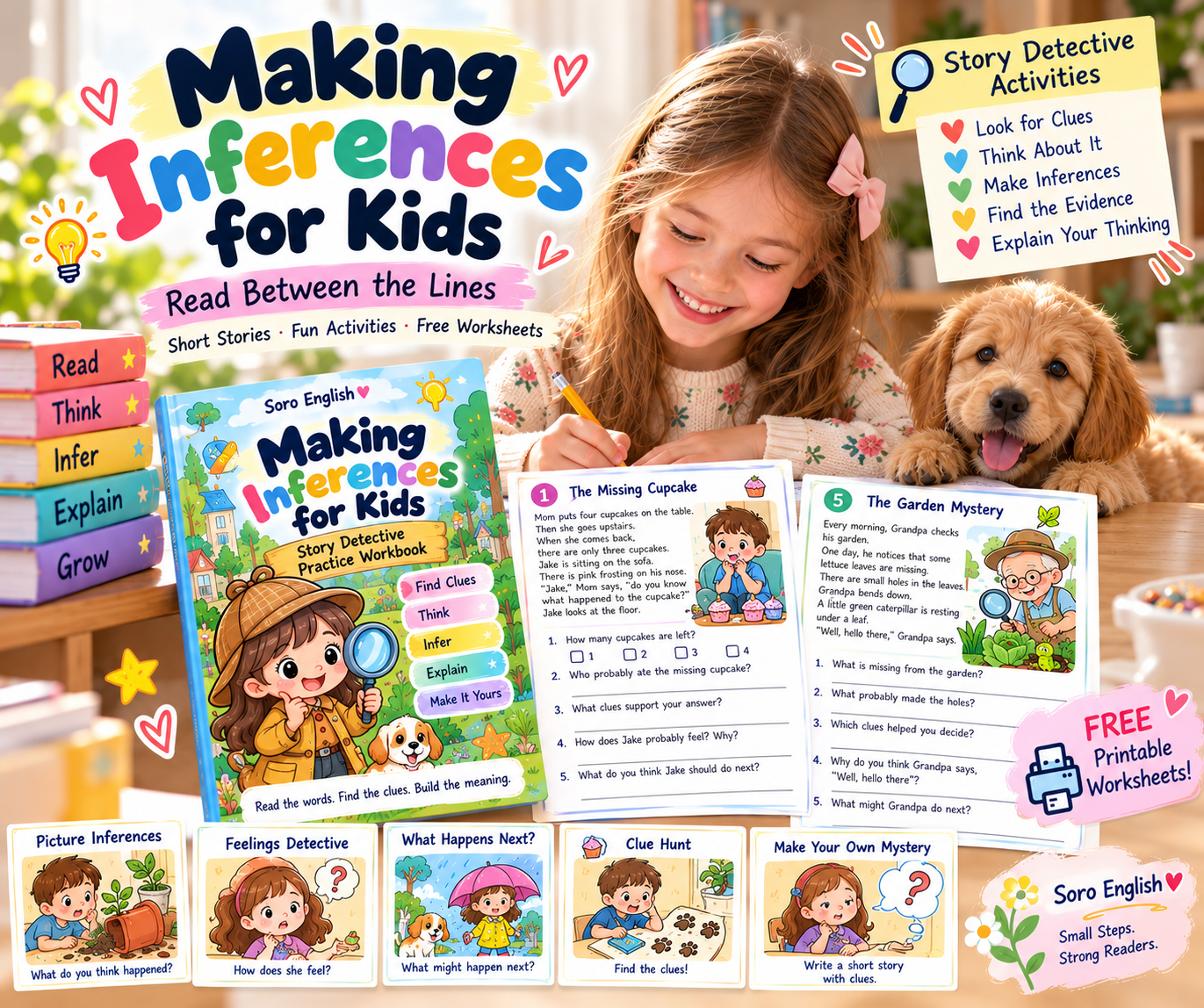
Simple inference activities, short stories, and reading comprehension tips for parents and teachers.
“It’s raining!”
“How do you know?”
“Because she’s holding an umbrella.”
I remember having conversations like this with young readers.
The child gives me the right answer. But when I ask how they know, they sometimes look surprised.
Isn’t getting the answer right enough?
Not quite.
I want children to do more than choose the correct answer. I want them to understand how they arrived at it.
And that is where one of my favorite reading skills comes in.
Making inferences.
It sounds like a complicated term, doesn’t it?
But children make inferences every day.
They see dark clouds and expect rain.
They notice someone crying and wonder what happened.
They find an empty cookie plate and crumbs on the floor and immediately become little detectives.
They’re already using clues to understand the world.
Our job is to help them do the same thing when they read.
Today, I’ll show you how to teach inference to beginning readers using simple examples, short stories, and activities you can try at home.
No complicated lessons.
Just a few good questions, some interesting clues, and a little curiosity.
What Is an Inference in Reading?
An inference is something we figure out by combining information from a text with what we already know.
The author doesn’t always tell us everything directly.
Sometimes we need to look for clues and think about what those clues might mean.
Here’s a simple way to explain it to children:
An inference is a smart idea based on clues.
I like to teach it with this formula:
Text Clues + What I know = My Inference
Let’s look at an example.
Emma puts on her rain boots. She picks up her umbrella and looks at the dark clouds outside.
The story never says:
It is going to rain.
But we can make a reasonable inference.
I think it might rain soon.
Why?
Because Emma has rain boots and an umbrella, and the sky is cloudy.
We’re not simply guessing.
We’re using evidence.
And that difference matters.
Inference vs. Guessing: What’s the Difference?
One of the biggest misunderstandings children have is that making an inference means guessing.
It doesn’t.
A guess can come from almost anywhere.
An inference needs support.
Imagine reading this sentence:
Ben opens the door and sees a puddle on the floor. His dog is standing beside an empty water bowl.
A child says:
“The dog probably spilled the water.”
That’s a reasonable inference.
Now imagine the child says:
“A dinosaur came into the house.”
It’s certainly imaginative!
But there isn’t enough evidence in the text to support it.
I don’t want to discourage creativity. I simply want children to understand that reading comprehension requires us to pay attention to what the author gives us.
Here’s a question I use often:
“Which clue made you think that?”
It’s gentle, simple, and surprisingly powerful.
Instead of telling children they’re wrong, we invite them to look again.
Start with Pictures Before Moving to Words
If you’re teaching inference to beginners, I wouldn’t start with a long reading passage.
I’d start with a picture.
Imagine a picture of a little boy standing beside a broken flowerpot.
There is soil on the floor.
His ball is nearby.
His eyes are wide open.
Ask your child:
- What do you notice?
- What do you think happened?
- How do you think the boy feels?
- What clues helped you decide?
Your child might say:
“I think the ball hit the flowerpot.”
Then ask:
“What makes you think that?”
They might point to the ball and the broken pot.
That’s inference.
And the child has just practised it without reading a single sentence.
Picture-based inference activities are especially helpful for children who are still learning to decode words.
They can focus on thinking without having to work so hard reading.
5 Types of Inference Every Beginning Reader Can Practise
Inference isn’t just one skill.
Children use it in different ways when they read.
I like to introduce these five types gradually.
- Inferring Feelings
Children look for clues about how a character feels.
Example:
Lily looks at her broken toy.
Her smile disappears.
She sits quietly on the floor.
Question: How does Lily probably feel?
Possible answer: Sad or disappointed.
Clue: Her smile disappears, and she becomes quiet.
Notice that the author never uses the word sad.
The reader figures it out.
2. Inferring What Happened
Children use clues to work out an event that isn’t directly explained.
Example:
There are muddy footprints across the kitchen floor.
Max’s dog is standing by the back door.
His paws are covered in mud.
Question: What probably happened?
Possible answer: The dog came inside with muddy paws.
Clue: The muddy footprints and the dog’s muddy paws.
3. Inferring Why a Character Acts a Certain Way
This type helps children understand motivations.
Example:
Noah puts his favorite cookie on a plate.
His little sister looks at it.
Noah breaks the cookie in half and gives her one piece.
Question: Why does Noah share his cookie?
Possible answer: He wants to be kind or make his sister happy.
Clue: He notices her looking at the cookie and shares it.
4. Inferring What Might Happen Next
Prediction and inference are closely connected.
A prediction uses clues to suggest what may happen later.
Example:
Dark clouds cover the sky.
The wind begins to blow.
Mia’s picnic blanket starts to move.
Question: What might happen next?
Possible answer: It may start raining, or Mia may need to pack up her picnic.
Clue: The dark clouds and strong wind.
A prediction doesn’t have to come true to be thoughtful.
It simply needs a reasonable explanation.
5. Inferring the Meaning of an Unfamiliar Word
Children can also context clues to understand vocabulary.
Example:
After running around the playground, Sam was exhausted. He sat on a bench and could barely keep his eyes open.
Question: What does exhausted probably mean?
a. very hungry
b. very tired
c. very angry
Answer: b. very tired
Clue: Sam has been running, needs to sit down, and struggles to keep his eyes open.
This is one reason inference is useful beyond comprehension questions. It can also support vocabulary learning.
5 Short Inference Stories for Kids
Now it’s time for the part children usually enjoy most.
Let’s solve some little mysteries.
You can read these stories aloud, let your child read independently if the text is manageable, or take turns reading.
The goal isn’t speed.
It’s noticing clues.
Story 1: The Missing Cupcake
Reading Skill: Inferring What Happened
Mom puts four cupcakes on the kitchen table.
Then she goes upstairs.
When she comes back, there are only three cupcakes.
Her son, Jake, is sitting on the sofa.
There is pink frosting on his nose.
“Jake.” Mom says, “do you know what happened to the cupcake?”
Jake looks at the floor.
Story Detective Questions
1.How many cupcakes are left?
2.Who probably ate missing cupcake?
3.What clues support your answer?
4.How many might Jake feel when Mon asks him about it?
5.What do you think Jake should do next?
Let’s Think Together
Jake probably ate the cupcake.
The frosting on his nose is a strong clue, although it doesn’t prove exactly what happened.
He might feel nervous, embarrassed, or guilty.
For the last question, encourage your child to explain that opinion.
“I think Jake should tell the truth because…”
This turns a simple mystery into a chance to practise reasoning and empathy.
Story 2: The Surprise Box
Reading Skill: Inferring Feelings
Ella walks into the living room.
Everyone suddenly becomes quiet.
Dad is holding a big box.
Mom is smiling.
There are colorful balloons near the window.
Ella looks at the calendar.
It’s her birthday!
Story Detective Questions
1.What special day is it?
2.What do you think is inside the box?
3.How does Ella probably feel?
4.Which clues tell you that something special is happening?
5.Have you ever received a surprise?
Let;s Think together
We know it;s Ella’s birthday.
We can reasonably infer that her family is preparing a birthday surprise.
But we don’t know exactly what’s inside the box.
It could be a toy, a book, or something else.
That’s an important distinction.
Some details are facts. Others are possibilities.
Helping children notice the different is part of becoming a thoughtful reader.
Story 3: The Wet Floor
Reading skill: Cause and Effect
Oliver walks into the bathroom.
The floor is wet.
A towel is lying beside the bathtub.
His little sister is standing near the sink.
There are drops of water on her shirt.
Oliver looks at the floor.
“What happened here?”he asks.
Story Detective Questions
1.Where does the story happen?
2.What might have caused the wet floor?
3.Find two clues that support your idea.
4.Can we know exactly what happened? Why or why not?
Let’s Think Together
His sister may have splashed water from the sink.
But it’s also possible that water spilled from the bathtub.
The text doesn’t give us enough information to know for certain.
This is a wonderful opportunity to teach children something I consider very important:
A good reader knows when the evidence is strong – and when more information is needed.
Story 4: The Quiet Playground
Reading Skill: Inferring a Character’s Feelings
Ben stands beside the swings.
Other children are playing together.
Ben watches them.
He takes one small step forward.
Then he stops.
He looks down at his shoes.
A girl walks over.
“Do you want to play with us?” she asks.
Ben smiles.
“Yes, please.”
Story Detective Questions
1.Where is Ben?
2.How might Ben feel at the beginning?
3.What clues support your answer?
4.How does his feeling change at the end?
5.What would you say to Ben if you were at the playground?
Let’s Think Together
Ben might feel shy, nervous, or unsure.
The clues are his hesitation and the way he looks down.
At the end, he seems happier or more comfortable.
I especially like the last question.
It gives children an opportunity to think about how their words can make someone else feel included.
Reading comprehension isn’t only about understanding events.
Stories can also help us think about people.
Story 5: The Garden Mystery
Reading Skill: Using Multiple Clues
Every morning, Grandpa checks his garden.
One day, he notices that some lettuce leaves are missing.
There are small holes in the other leaves.
Grandpa bends down.
A little green caterpillar is resting underneath a leaf.
“Well, hello there.” Grandpa says.
Story Detective Questions
1.What is missing from the garden?
2.What probably made the holes in the leaves?
3.Which clues helped you decide?
4.Why do you think Grandpa says, “Well, hello there?”
5.What might Grandpa do next?
Let’s Think Together
The caterpillar probably ate some of the lettuce.
We know that caterpillars eat leaves, and Grandpa finds one near the damaged lettuce.
Still, the story doesn’t prove that this particular caterpillar caused every hole.
That’s what makes this a useful inference activity.
Children can practise making reasonable conclusions without confusing them with facts.
The Most Useful Sentence Frame for Teaching Inference
If I could choose just one sentence frame for beginning readers, it would be this:
I think __________ because __________.
It’s simple enough for young children.
But it teaches two important habits.
First, children learn to express an idea.
Second, they learn to support it.
Let’s try a few examples.
I think Ben was nervous because he stopped and looked down at his shoes.
I think Jake ate the cupcake because there was frosting on his nose.
I think the caterpillar ate the lettuce because there were holes in the leaves.
When children struggle to explain their thinking, I don’t immediately give them the answer.
Instead, I might ask:
“Can you find a clue?”
“Which sentence helped you?”
“What do you already know about this?”
Those little questions can help children become more independent.
6 Fun Inference Activities to Try at Home
You don’t need expensive materials or complicated lesson plans.
Most of these activities take just a few minutes.
1.Mystery Bag
Put an object inside a bag.
Give your child three clues.
For example:
- It is round.
- You can throw it.
- Children play with it outside.
Your child guesses the object and explains which clues helped.
What it practises: Combining clues and background knowledge.
2.What’s in the Picture?
Show your child a picture with an interesting situation.
Ask:
“What do you notice?”
“What do you think happened?“
“What makes you think that?”
What it practises: Visual inference and evidence-based reasoning.
3. The Missing Sentence
Read a short story, but leave out one important sentence.
Ask your child what might be missing.
For example:
Lucy puts on her coat and scarf.
[Missing sentence]
Soon, she is building a snowman.
What might have happened between those sentences?
What it practises: Connecting events and using context.
4. Feelings Detective
Read a short sentence that shows a character’s actions but doesn’t name the emotion.
For example:
Tom jumps up and down. He claps his hands and shouts, “We won!”
Ask:
“How does Tom feel?”
“How do you know?”
What it practises: Recognising emotional clues.
5. Clue Hunt
After reading a short story, give your child a highlighter or colored pencil.
Ask them to underline the words that helped them answer a question.
I particularly like this activity because it makes invisible thinking visible.
Children can actually point to their evidence.
What it practises: Close reading and finding text evidence.
6. Make Your Own Mystery
Let your child create a tiny mystery.
For example:
There are crumbs on the table.
The cookie jar is open.
My brother has chocolate on his fingers.
Then ask someone else to solve it.
What it practises: Understanding how authors give readers clues.
And, of course, it encourages creativity.
5 Common Mistakes When Teaching Inference
Over the years, I’ve noticed that some well-intentioned teaching habits can make inference harder than it needs to be.
Here are five I’d avoid.
Mistake 1: Starting with Texts That Are Too Difficult
If children are struggling to read every other word, they may have little attention left for understanding.
Choose short, manageable passages or read the story aloud first.
Inference is a thinking skill. We don’t want decoding difficulties to hide what a child can understand.
Mistake 2: Asking Too Many Questions
A child doesn’t need ten inference questions after every story.
Sometimes one thoughtful question is enough.
I’d rather hear a child explain one answer well than rush through ten guesses.
Mistake 3: Accepting Every Answer Without Checking the Evidence
I love creative answers.
But creativity and textual evidence are not the same thing.
If a child suggests an unusual explanation, ask:
“Can you find something in the story that supports your ides?”
If they can’t, that’s okay.
Help them return to the clues.
Mistake 4: Treating Every Inference as Having One Correct Answer
Some inferences are strongly supported.
Others allow several reasonable possibilities.
When the text leaves room for interpretation, children should be allowed to explain different answers.
The important question is:
“Does the evidence support your idea?”
Mistake 5: Correcting Too Quickly
When a child pauses, adults often want to help immediately.
I understand that feeling.
But sometimes a few extra seconds make all the difference.
Let your child think.
Let them look back at the text.
Let them change their mind.
That process is part of learning.
How to Teach Inference in Just 10 Minutes a Day
Here’s a simple routine you can use at home.
Minutes 1-2: Read
Choose one short passage.
Read together or let your child read independently.
Minutes 3-4: Notice
Ask:
“What details did you notice?”
Minutes 5-6: Think
Ask one inference question.
“What do you think happened?”
“How does the character feel?”
“Why might they have done that?”
Minutes 7-8: Find the Clue
Ask:
“Which words helped you?”
Encourage your child to point to the evidence.
Minutes 9-10: Explain
Use the sentence frame:
I think _________ because __________.
And you’re done.
No longer worksheet session required.
Just a short, thoughtful reading conversation.
Free Making Inferences Worksheets for Kids
Want to give your child more opportunities to practise?
Our Soro English Story Detective activities help children move from simply finding answer to explaining their thinking.
The goal isn’t to turn every story into a test.
It’s to help children become curious, observant readers who know how to support their ideas.
[ Download Free Making Inferences Worksheets for kids – add your PDF link here]
Read the words. Find the clues. Build the meaning.
Frequently Asked Questions About Making Inferences
What age should children start learning to make inferences?
Children can begin practising simple inferences before they read independently. Picture books, everyday situation, and read – aloud conversations are good starting points.
As decoding and language skills develop, children can practise making inferences from short written passages.
What is the easiest way to explain inference to a child?
Try:
“An inference is something you figure out using clues and what you already know.”
Then show a simple example.
If someone is wearing a raincoat and holding an umbrella, what might the weather be like?
Why does my child struggle with inference questions?
There can be several reasons.
The text may be too difficult, the vocabulary may be unfamiliar, or the child may not have enough background knowledge to connect the clues.
Sometimes children understand the story but struggle to explain their reasoning.
Try shorter texts, picture clues, and simple sentence frames.
Is making an inference the same as predicting?
Not exactly.
Both use evidence and background knowledge.
An inference helps us figure out something that isn’t directly stated.
A prediction is an evidence-based idea about what might happen next.
How can I tell if my child is improving?
Look beyond correct answers.
Notice whether your child can identify clues, explain their thinking, reconsider an answer, and distinguish what the story says from what they think it means.
Those are meaningful signs of progress.
Should I use inference worksheets every day?
Not necessarily.
Worksheets can be useful, but conversations during everyday reading matter too.
A few thoughtful questions while reading a picture book can prove valuable practice.
The Moment a Child Becomes a Story Detective
One of my favorite moments in teaching isn’t when a child gets every answer right.
It’s when a child says:
“Wait! I found a clue!”
They turn back a page.
They point to a sentence.
They explain something I haven’t told them.
And suddenly, reading feels less like completing an assignment and more like solving a little mystery.
That’s what I want children to experience.
Not pressure to find the perfect answer.
Not fear of making a mistake.
But the excitement of discovering meaning for themselves.
Because the best readers don’t just see the words on a page.
They notice what’s happening between them.
Read the words. Find the clues. Build the meaning.
Small Steps. Strong Readers.
-Soro English
Keep Learning with Soro English
If your child is still developing reading comprehension skills, you may also enjoy:
- Reading Comprehension for Beginners: How to Help Kids Understand What They Read
- Reading Comprehension Passages for Beginners: 10 Short Stories with Questions
- Decodable Reading Passages for Beginners: Short Phonics Stories and Activities
Each step builds on the before it, helping children grow from beginning readers into thoughtful, confident readers.
Next up: Teaching Kids to Find Text Evidence- How to Answer “How Do You Know?”
test