There is a question I like to ask after a child finishes reading.
Not:
“How many words did you read?”
Not even:
“Did you get all the questions right?”
I simply ask:
“What do you remember?”
Sometimes I get the whole story.
Sometimes I get one sentence.
And sometimes I get:
“Umm…I don’t know.”
That last answer tells me something important.
A child can reach the final word on a page without really carrying the story with them.
That’s why, once children begin reading short texts independently, I don’t just want to give them more to read.
I want to help them become children who notice, wonder, remember and think while they read.
So today, we’re going to do something a little different.
No long explanations.
No complicated reading rules.
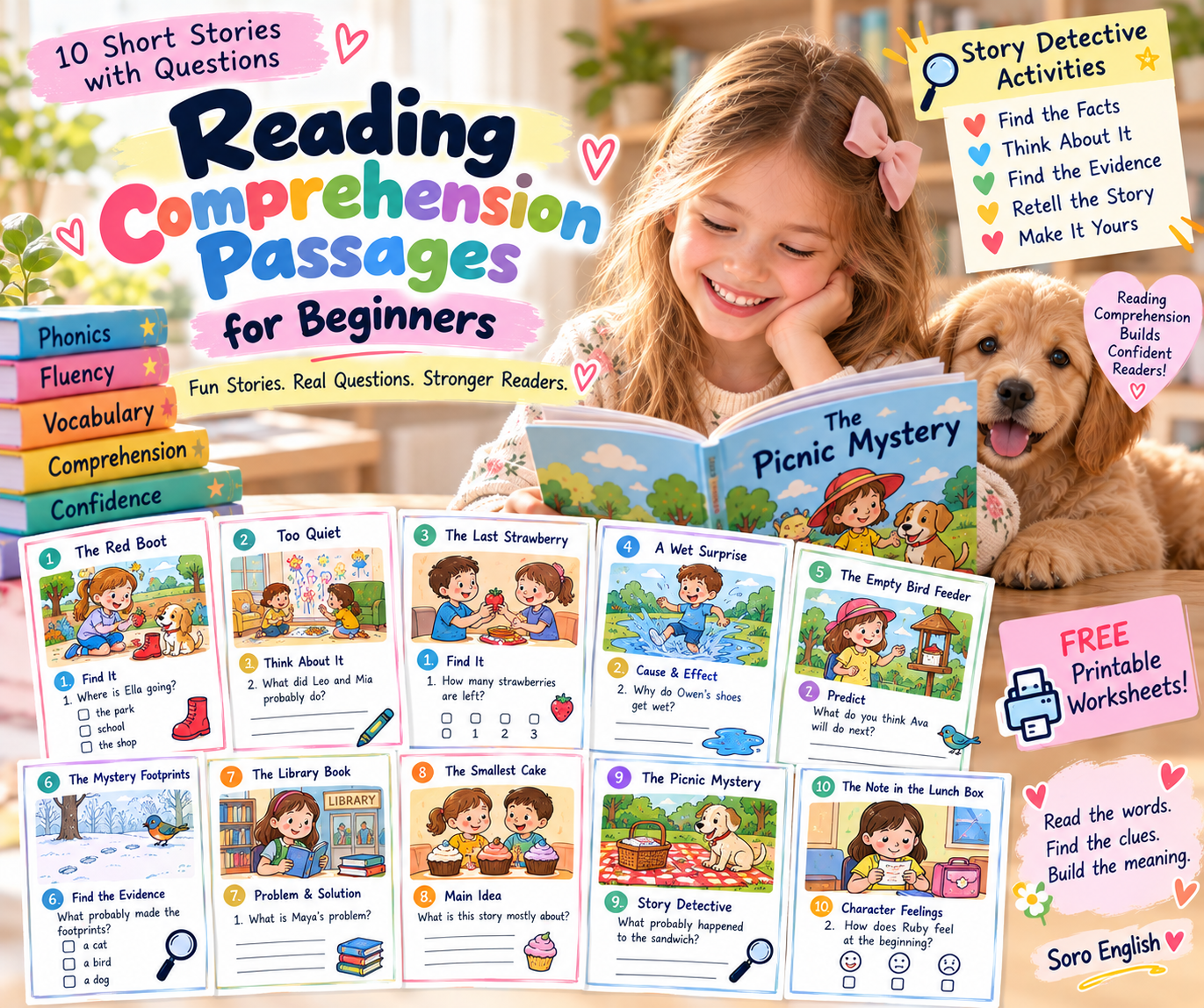
Just 10 short reading comprehension passages for beginners and one simple mission:
Reading the story. Find the clues. Build the meaning.
Welcome back, Story Detectives.🔎
Before you Start : Don’t Rush to the Questions
Here’s something I’d love parents to try.
After your child reads each passage, don’t immediately point to Question 1.
Wait.
Then ask:
“What happened?”
Give your child a chance to tell you.
Even a simple answer such as:
“The boy lost his shoe.”
or:
“The dog ate the sandwich.”
is meaningful.
Then move to the questions.
At Soro English, I like to use five little steps:
🔎 FIND IT
What does the story tell you?
💭 THINK ABOUT IT
What can you figure out?
🔍 PROVE IT
Which words helped you know?
🗣️ TELL IT
Can you explain what happened?
❤️ MAKE IT YOURS
What do you think?
We won’t need all five steps for every story.
Sometimes two or three are enough.
Ready?
Let’s read.
Passage 1: The Red Boot
Reading Focus: Finding Details
Ella is getting ready for school.
She puts on one red boot.
Then she looks for the other one.
It isn’t by the door.
It isn’t under her bed.
Ella looks beside the sofa.
There it is!
Her little dog is sleeping next to the red boot.
“You found my boot first!” Ella says.
The dog wags its tail.
🔎 Find It
1.Where is Ella going?
a. The park
b. School
c. The shop
2. Where does Ella find her boot?
💭 Think About It
3. Who probably moved the boot?
🔍 Prove It
What clue helped you think that?
❤️ Make It Yours
Where is the funniest place you’ve ever found something you lost?
Passage 2: Too Quiet
Reading Focus: Making an inference
Mom is making dinner.
Leo is playing in the living room.
His little sister, Mia, is playing too.
Then the house becomes very quiet.
Mom stops chopping the carrots.
“Why is it so quiet?”she asks.
She walks into the living room.
No Leo.
No Mia.
Mom looks behind the sofa.
Leo and Mia are sitting on the floor.
A box of crayons is open.
The wall behind them is covered in colorful lines.
Mom closes her eyes for a moment.
“Oh, dear.”
🔎 Find It
1.What is Mom making?
💭 Think About It
2.What did Leo and Mia probably do?
3. How do you think Mom feels?
a. surprised or upset
b. sleepy
c. excited
🔍 Prove It
Find two clues that helped you answer Question 2.
Clue 1:
Clue 2:
Story Detective Tip 🔍
Sometimes the author doesn’t tell us everything.
We put clues together to figure it out.
That’s called making an inference.
Passage 3: The Last Strawberry
Reading Focus: Character Feelings
There is one strawberry left on the plate.
Nora reaches for it.
Her brother, Sam, reaches for it too.
They stop.
They look at the strawberry.
Then they look at each other.
“You can have it.”says Sam.
Nora thinks for a moment.
She picks up the strawberry.
Then she cuts it in half.
“One for you and one for me.”
Sam smiles.
🔍 Find It
1.How many strawberries are left?
💭 Think About It
2.Why does Sam smile at the end?
❤️ Make It Yours
What would you have done with the last strawberry?
One More Thought
Which word best describes Nora?
kind / angry / scared / careless
Why?
Passage 4: A Wet Surprise
Reading Focus: Cause and Effect
Owen wants to play outside.
He looks through the window.
The sun is shining.
Owen runs into the garden.
His ball is beside the tree.
He kicks it.
SPLASH!
Water flies everywhere.
Owen looks down.
His shoes are wet.
He didn’t see the big puddle hiding in the grass.
Owen starts to laugh.
🔎 Find It
- What does Owen kick?
➡️ Cause & Effect
2. Why do Owen’s shoes get wet?
💭 Think About It
3. Why might Owen laugh instead of getting angry?
🗣️ Tell It
Tell someone what happened using just two sentences.
Passage 5: The Empty Bird Feeder
Reading Focus: Prediction
Every morning, Ava puts seeds in the bird feeder.
Then she sits by the window.
Sparrows come.
A little blue bird comes too.
One morning, Ava looks outside.
No birds.
She checks the feeder.
It is empty.
Ava gets the bag of seeds.
✋🏻 STOP !
What do you think Ava will do next?
Why?
📖 Read On
Ava fills the feeder with fresh seeds.
Then she waits.
Soon, one sparrow lands on it.
Then another.
“Welcome back.” Ava whispers.
🔎 Check Your Prediction
Were you right?
☐ Yes
☐ Almost
☐ I had a different idea
Remember:
A good prediction doesn’t have to be correct. It needs a good clue.
Passage 6: The Mystery Footprints
Reading Focus: Using Evidence
It snowed during the night.
In the morning, Jack opens the back door.
He sees tiny footprints in the snow.
They start near the tree.
They cross the garden.
Then they stop beside the bird feeder.
Jack looks up.
A little bird is eating seeds.
“I know who made those tracks!”he says.
🔎 Find It
- Where do the footprints stop?
💭 Think About It
2. What probably made the footprints?
🔎 Prove It
Find two clues.
Clue 1:
Clue 2:
🕵️ Detective Verdict
I think _________________ made the footprints because _______________.
Passage 7: The Library Book
Reading Focus: Problem and Solution
Maya loves her library book.
She reads it after breakfast.
She reads it in the car.
She even reads it under her blanket with a flashlight.
On Saturday morning, Dad asks,
“Isn’t your library book due today?”
Maya freezes.
The library closes in thirty minutes.
She puts on her shoes.
Dad grabs the car keys.
“Let’s go!”
They reach the library just before it closes.
Maya puts the book in the return box.
“Phew!”
🔎 Find It
1.What is Maya’s problem?
💡 Solution
2. How does she solve it?
💭 Think About It
3. How does Maya probably feel when she remembers the due date?
4. How does she feel at the end?
Find the Clue
Which word at the end gives you a clue?
Passage 8: The Smallest Cake
Reading Focus: Main Idea
Dad makes three little cakes.
One is pink.
One is yellow.
One is chocolate.
Lily wants the chocolate cake.
Her little brother wants it too.
Lily looks at him.
He looks at the cake.
Then Lily gives him the chocolate one.
She takes the smallest yellow cake.
“Thank you!” her brother says.
Lily smiles.
💡 What Is This Story Mostly About?
a. how to bake a cake
b. Lily choosing to be kind to her brother
c. why chocolate tastes good
🔎 Find a Detail
What does Lily give her brother?
💭 Think Deeper
Why is the title “The Smallest Cake” important?
❤️ Make It Yours
Do you think Lily made a good choice?
Why?
Passage 9: The Picnic Mystery
Reading Focus: Inference and Evidence
Dad puts a sandwich on the picnic blanket.
“Don’t touch it yet.” he says.
The family goes to play with a ball.
Their dog, Coco, stays near the blanket.
Ten minutes later, everyone comes back.
The sandwich is gone.
“That’s strange.” says Dad.
Coco is sitting under a tree.
There are crumbs beside his paws.
He licks his mouth.
Everyone looks at Coco.
Coco wags his tail.
🕵🏻♀️ STORY DETECTIVE CASE
What probably happened to the sandwich?
Find THREE clues.
🔎 Clue 1:
🔎 Clue 2:
🔎 Clue 3:
Detective Verdict
I think _________ because___________.
❤️ Make It Yours
What do you think Dad should do next?
Passage 10: The Note in the Lunch Box
Reading Focus: Understanding Feelings and Meaning
Ruby has a spelling test today.
At breakfast, she barely eats.
In the car, she is very quiet.
At school, Ruby opens her lunch box.
There is a small yellow note inside.
It says:
You’ve practised hard. Just do your best. Love, Dad.
Ruby reads it twice.
She folds the note and puts it in her pocket.
Then she takes a deep breath.
“I can do this.” she whispers.
🔎 Find It
1.What does Ruby have today?
💭 Think About It
2. How does Ruby probably feel at the beginning?
What clues tell you?
3. How does the note change Ruby’s feelings?
❤️ Make It Yours
What would you write on a note to encourage Ruby?
Don’t Stop at the Correct Answer
If your child says:
“Coco ate the sandwich.”
it’s tempting to say:
“Correct!”
and move on.
But try one more question:
“What made you think that?”
Now something different happens.
The child has to return to the story.
Maybe they say:
“There were crumbs by his paws.”
Or:
“He was licking his mouth.”
That’s the part 1 care about.
Because we’re moving from:
I know the answer.
to:
I know why I think that’s the answer.
That’s a much stronger reading habit.
5 Questions I Use Again and Again
You don’t need a new set of comprehension questions for every book.
These five can take you surprisingly far:
- What happened?
- How did the character feel?
- What makes you think that?
- What do you think will happen next?
- What would you do?
Notice that some answers come directly from the text.
Some require clues.
And some belong entirely to the child.
That’s exactly what I want.
Reading should involve both understanding the author’s words and developing your own thoughts about them.
A Simple Reading Comprehension Routine for Home
If you’re using these passages at home, don’t try to complete all ten at once.
One story is enough.
Try:
1. READ 📖
Let your child read the passage.
2. TELL ME 🗣️
Before looking at the questions, ask:
“What happened?”
3. FIND IT 🔎
Ask one question with an answer directly in the story.
4. THINK 💭
Ask one question that requires a clue.
5. PROVE IT 🔎
Ask:
“What words helped you?”
6. MAKE IT YOURS ❤️
Finish with:
“What do you think?”
Then close the page.
Reading practice doesn’t need to become a 40-minute test.
What If the Questions Are Too Difficult?
Make them easier.
That’s not cheating.
If:
“Why do you think the character felt disappointed?”
is too difficult, try:
“Was she happy or sad?”
Then:
“What happened?”
Later, return to:
“How do you know?”
Comprehension develops in layers.
We don’t need to jump to the top layer immediately.
What If My Child Can Answer but Can’t Explain Why?
This is very common.
Use this sentence frame:
I think __________ because ___________.
For example:
I think Ruby was nervous because she was quiet and didn’t eat much breakfast.
Or:
I think Coco ate the sandwich because there were crumbs beside his paws.
That one little word –
because
-helps children connect an idea with evidence.
I use it a lot.
Free Reading Comprehension Worksheets for Beginners
If your child enjoys these stories, I’ve also created a printable Reading Comprehension Story Detective Pack for beginning readers.
It includes activities for:
🔎 finding key details
💭 making simple inferences
🔎 finding text evidence
🔢 sequencing events
❤️ understanding character feelings
🔮 making predictions
➡️ cause and effect
💡finding the main idea
✋🏻 retelling stories
🕵🏻♀️ solving reading mysteries
The activities aren’t designed to make children answer as many questions as possible.
They’re designed to help children learn what to think about while they read.
Download the Free Reading Comprehension Worksheets for Beginners
Read the words. Find the clues. Build the meaning.
Frequently Asked Questions
What reading comprehension skills should beginners learn first?
Start with concrete skills such as identifying characters, setting and important events. Once those feel comfortable, gradually introduce sequencing, prediction, character feelings, simple inference and finding evidence.
How long should a beginner reading passage be?
Short enough that decoding doesn’t use all of the child’s energy. For some children, that may mean only a few sentences. As reading becomes easier, passages can gradually become longer.
How many comprehension questions should I ask?
More isn’t necessarily better. A few purposeful questions can tell you much more than a long page of repetitive questions.
Should children look back at the passage for answers?
Absolutely.
Going back to check the text is a useful reading habit.
I often tell children:
“Don’t guess. Investigate.”
What if my child gives a different answer from the answer key?
Ask:
“What made you think that?”
For inference and opinion questions, more than one answer may be reasonable when the child can support it with information from the text.
Should I correct every grammar mistake when my child answers?
Not during every comprehension discussion.
If I ask:
“Why was Ruby nervous?”
and the child communicates a sensible answer, I want to keep the focus on understanding first.
There will be other opportunities to work on language accuracy.
From “What Is the Answer?” to “Here’s What I Think”
There is a small change I love seeing in young readers.
At first, they look at me after every question.
Their face seems to ask:
“Is this right?”
Later, something changes.
They look back at the story.
They point to a sentence.
And they say:
“I think this because…”
That’s a very different kind of reader.
They’re not simply waiting for an adult to approve an answer.
They’re learning to look for clues, connect ideas and explain their thinking.
And eventually, I hope they won’t need my questions at all.
They’ll read a story and wonder:
Why did she do that?
What’s going to happen?
Wait…was that the clue?
I think I know!
That’s when comprehension stops being something we test after reading.
It becomes part of reading itself.
And that’s exactly where I want our beginning readers to go.
Don’t just find the answer. Find the reason.
Small Steps. Strong Readers.
Try five short reading passages with questions and answers
–Soro English