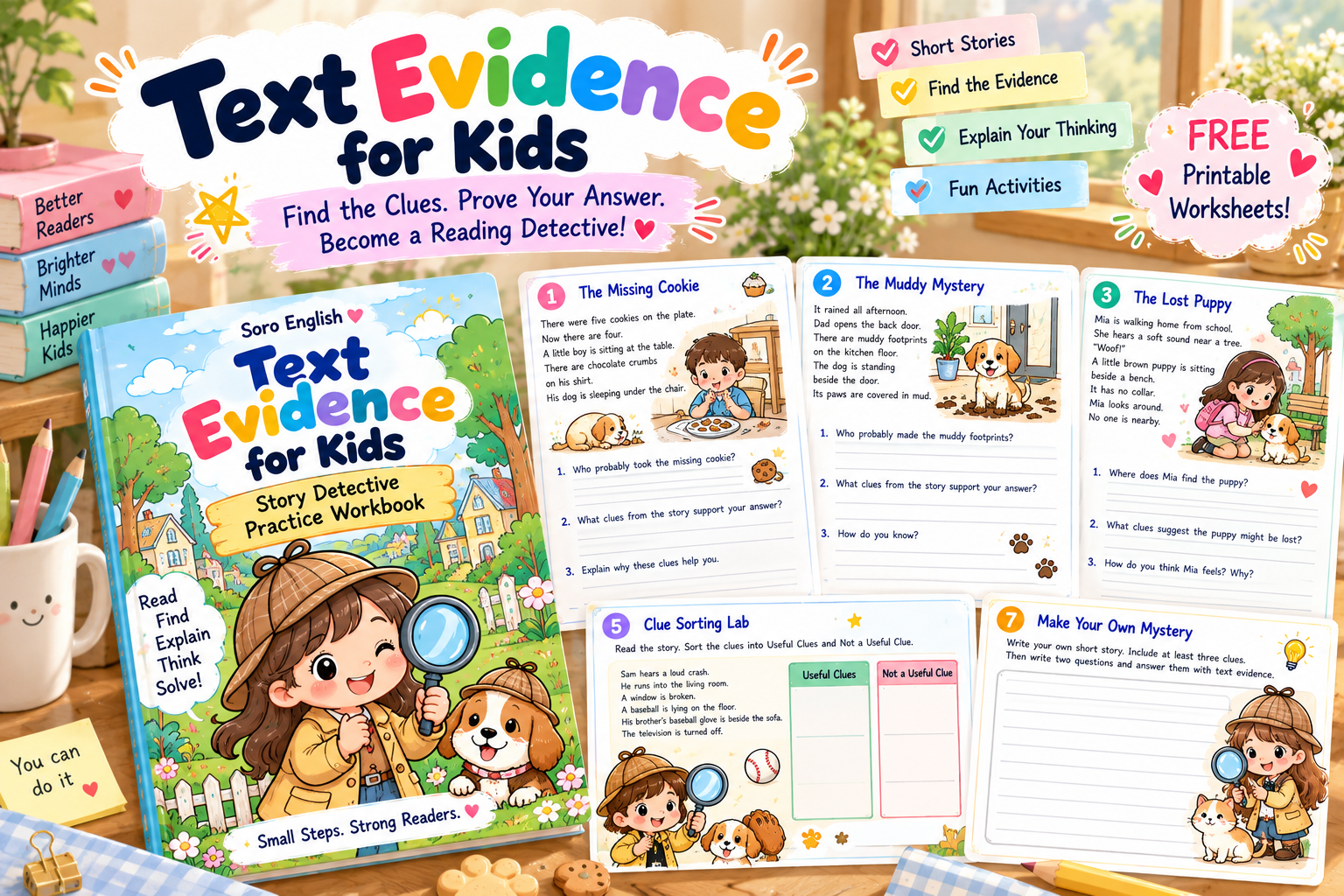
Fun reading activities, short mystery stories, and simple strategies to help children find evidence in a text.
The Case of the Missing Cookie
There were five cookies on the plate.
Now there are four.
A little boy is sitting beside the table.
There are chocolate crumbs on his shirt.
His dog is sleeping under the chair.
Who took the missing cookie?
If you ask a child this question, you might get an answer immediately.
“The boy!”
“Are you sure?”
“Yes!”
“How do you know?”
And suddenly, the conversation becomes much more interesting.
The child looks back at the story.
“Because he has crumbs on his shirt!”
There it is.
Not just an answer.
A reason.
Of course, the crumbs don’t prove that the boy took the cookie. But they give us a clue that makes his involvement reasonable possibility.
And that’s exactly what I want children to notice.
Good readers don’t just tell us what they think.
They can explain why they think it.
Today, we’re going to learn how to find text evidence through short stories, silly mysteries, and a few questions that can completely change the way children read.
Grab your imaginary magnifying glass.
We have a case to solve.
First What Is Text Evidence?
Let’s keep this simple.
Text evidence is information from a story or passage that supports an answer or idea.
Sometimes the evidence is one word.
Sometimes it’s a sentence.
Sometimes we need to put two or three details together.
Imagine reading:
The sky turned dark. Mia opened her umbrella. Large drops began hitting the sidewalk.
Question: What was the weather like?
Answer: It was raining.
Text evidence: Large drops began hitting the sidewalk.
The answer is directly supported by the story.
Now try something different.
Jack stood in front of the classroom. His hands were shaking. He looked down at his speech notes.
Question: How might Jack feel?
Answer: He might feel nervous.
Evidence: His hands were shaking, and he kept looking at his netes.
This time, the author doesn’t actually say nervous.
we use evidence to support an inference.
That’s an important difference.
Text evidence can help us answer both literal and inference questions.
The Question That Changes Everything
There is one question I come back to again and again when teaching reading.
“How do you know?”
It sounds almost too simple.
But think about what happens when we ask it.
A child must pause,
Remember the story.
Look for useful information.
Connect that information to an answer.
And explain the connection.
That’s a lot of thinking inside four little words.
But there’s one thing I want parents to be careful about.
“How do you know?” shoul sound like an invitation, not an interrogation.
If a child already feels unsurem repeating the question sharply can make them afraid to answer.
I prefer a warm, curious tone.
“That’s interestiong. What helped you think that?”
“Can we find a clue together?”
“Which part of the story gave you that idea?”
We’re not trying to catch children making mistakes.
We’re teaching them to become curious readers who know how to investigate.
The Three-Step Evidence Hunt
I use a simple routine that children can remember.
1.SAY IT
Tell me your answer.
2.FIND IT
Go back to the story and find a clue.
3. EXPLAIN IT
Tell me how the clue supports your answer.
That’s it.
Say it ➡️ Find it ➡️ Explain It
Let’s practise.
Mini Story: The Forgotten Lunch
Sophie opens her school bag.
Her lunch box isn’t there.
She looks in every pocket.
Then she remembers something.
This morning, she put her lunch box on the kitchen table.
“Oh no.” Sophie whispers.
SAY IT
Question : Where is Sophie’s lunch box probably still sitting?
Answer: On the kitchen table.
FIND IT
Evidence: “This morning, she put her lunch box on the kitchen table.”
EXPLAIN IT
I think her lunch box is still on the kitchen table because that’s where she last remembers putting it.
Notice the word probably.
The story doesn’t explicitly tell us that the lunch box is still there.
But the clue makes it a reasonable conclusion.
And that’s what evidence-based reading is all about.
Let’s Play : Evidence or Just a Guess?
Here’s a game I love because children quickly understand the difference between an idea and a supported idea.
Read the short story.
The Muddy Mystery
It rained all afternoon.
Dad opens the back door.
There are muddy footprints on the kitchen floor.
The dog is standing beside the door.
Its paws are covered in mud.
Dad looks at the dog.
“Well, well, well.”
Question: Who probably made the muddy footprints?
Now look at these answers.
Answer A: The dog probably made them because its paws are muddy.
Answer B: A giraffe made them because giraffes are funny.
Answer C: A superhero flew into the kitchen.
Which answer is best supported?
Answer A.
Why?
Because the text gives us relevant clues about the dog’s muddy paws and its position near the door.
Answers B and C might be entertaining, but the story doesn’t support them.
Here’s the lesson I want children to remember:
An interesting answer isn’t always an evidence-based answer.
And yes, children are absolutely allowed to laugh at the giraffe.
Reading should still be fun.
5 Text Evidence Activities Kids Actually Enjoy
We don’t need to turn every reading lesson into another worksheet.
Sometimes the best learning happens when children feel like they’re playing.
Here are five activities I recommend.
Activity 1: The Evidence Detective
Best for: finding explicit details
You need: A short story and a colored pencil
Read a paragraph together.
Ask one question.
Then say:
“Detective, your mission is to find the sentence that proves your answer.”
Your child underlines the evidence.
For example:
Lily put on her yellow raincoat before walking outside.
Question: What color is Lily’s raincoat?
Answer: Yellow.
Evidence: yellow raincoat
Start with questions like this because the evidence is easy to find.
Once children become comfortable, introduce questions that require more thinking.
Teacher Tip: Don’t ask children to underline an entire paragraph if only a few words are needed. Help them choose the most relevant evidence.
Activity 2: Two Clues Are Better Than One
Best for: Supporting inferences
Read this short story.
The Nervous Performer
Ben waits behind the stage curtain.
He checks his shoes again.
His hands feel cold.
He takes three deep breaths.
Then someone calls his name.
Question: How does Ben probably feel?
Possible answer: Nervous.
Now ask your child to find two clues.
Clue 1: He checks his shoes again.
Clue 2: He takes three deep breaths.
Together, these details support the inference that Ben may be nervous.
Try this sentence:
I think Ben feels __________ because __________ and __________.
This activity helps children understand that one clue isn’t always enough.
Activity 3: Evidence Sorting Game
Best for: Distinguishing relevant and irrelevant information
Read this short passage.
The Broken Window
Sam hears a loud crash.
He runs into the living room.
A window is broken.
A baseball is lying on the floor.
His brother’s baseball glove is beside the sofa.
The television is turned off.
Question: What might have broken the window?
Now sort the clues.
Useful clues:
- A baseball is lying on the floor.
- The window is broken.
Less useful clue:
- The television is turned off.
Ask:
“Which details actually help us answer the question?”
This is an important reading skill.
Not every detail in a story is equally useful for every question.
A baseball is a reasonable possible cause, but the passage doesn’t prove how the window broke.
Activity 4: Prove Me Wrong!
Best for: Checking unsupported claims
This one usually makes children laugh.
Read:
Emma wears her boots and carries an umbrella.
Dark clouds cover the sky.
Then make a deliberately silly claim.
“I think Emma is getting ready to go swimming!”
Your child becomes the teacher.
They must explain why your answer isn’t well supported.
You can ask:
“What does the story actually tell us?”
“What would be a better answer?”
“Which clue supports your idea?”
Children often enjoy correcting an adult.
And they’re practising careful reading at the same time.
Activity 5: The Evidence Challenge
Best for: Independent comprehension
Give your child a short story and three questions.
For each question, ask them to complete:
My Answer: ____________________
My Evidence: ____________________
My Explanation: ____________________
You can even give them a small detective badge when they complete the challenge.
The reward isn’t for getting every answer right.
It’s for trying to support their thinking.
3 Short Reading Passages with Text Evidence Questions
Let’s put everything together.
These passages are short enough for a quick lesson but rich enough to encourage discussion.
Passage 1: The Lost Puppy
Mia is walking home together.
She hears a soft sound near a tree.
“Woof!”
A little brown puppy is sitting beside a bench.
It has no collar.
Mia looks around.
No one is nearby.
She kneels down and speaks softly.
“Are you lost, little one?”
The puppy wags its tail.
Questions
- Where does Mia find the puppy?
- What clues suggest the puppy might be lost?
- How does Mia probably feel about the puppy?
- Which words support your answer?
- What should Mia do next?
Let’s Check the Evidence
1. Beside a bench near a tree.
2. The puppy has no collar, and no one is nearby.
3. Mia may feel concerned or caring.
4. She kneels down and speaks softly.
5. Answers may vary. A sensible suggestion is to ask a trusted adult for help locating the owner.
Important: The puppy might be lost, but we don’t know for certain. That’s the difference between a clue and a confirmed fact.
Passage 2: The Birthday Secret
Dad is baking a cake.
He asks Olivia to keep the kitchen door closed.
There are balloons hidden in a large bag.
Mom is coming home in one hour.
Olivia smiles.
Questions
- What is Dad making?
- Who is probably having a birthday?
- Find two clues that support your answer.
- Why might Dad want the kitchen door closed?
- What do you think will happen when Mom comes home?
Let’s Check the Evidence
1. A cake.
2. Probably Mom.
3. Dad is baking a cake, balloons are hidden in a bag, and Mom is coming home soon. These clues suggest they may be planning a birthday surprise for Mom.
4. He may want to keep the surprise secret.
5. Possible answer: Mom may be surprised by the birthday celebration.
Notice how this story requires children to combine several details.
That’s exactly what makes it useful for text evidence practice.
Passage 3: The Empty Nest
Every spring, Grandpa watches a small nest in the tree.
Two birds build it together.
Soon, there are three little eggs.
Grandpa checks the nest from a distance each morning.
One day, he hears tiny chirping sounds.
He looks up.
The eggs are broken, and three baby birds are moving inside the nest.
Grandpa smiles.
Questions
- How many eggs were in the nest?
- What probably happened to the eggs?
- Which clues support your answer?
- Why does Grandpa smile?
- What might happen as the baby birds grow?
Let’s Check the Evidence
1. Three
2. The eggs hatched.
3. The broken eggs and the three baby birds.
4. He may feel happy or excited to see the baby birds.
5. They may grow feathers and eventually learn to fly.
This story also gives us an opportunity to discuss how observations help us understand events.
What If My Child Can’t Find the Evidence?
This is where I think adults can make the biggest difference.
Imagine your child answers correctly but can’t explain why.
Instead of saying:
“No, go back and read it again.”
Try:
“Let’s look at this part together.”
Then narrow the search.
If the passage has eight sentences, point to the two or three most relevant ones.
Ask:
“Which sentence helps us?”
You can even read those sentences aloud.
The goal is to teach children how to locate evidence – not to make them feel that they should already know how.
Try the Gradual Release Method
A useful teaching approach is to model the skill first, practise together, and then let the child try independently.
I DO: I show you how to find evidence.
WE DO: We find evidence together.
YOU DO: You try it on your own.
For example:
First story: The adult models the answer and evidence.
Second story: The adult and child work together.
Third story: The child tries independently.
It’s a simple structure, but it helps children gain confidence without feeling overwhelmed.
Teaching Text Evidence vs. Making Inferences
Parents sometimes wonder whether these are the same reading skill.
They’re connected, but they aren’t identical.
Making an inference means using clues and background knowledge to figure out something the author hasn’t directly stated.
Finding text evidence means identifying information in the text that supports an answer or interpretation.
For example:
Ruby looks at her spelling test. Her hands shake. She takes a deep breath.
Inference: Ruby might be nervous.
Text Evidence: Her hands shake, and she takes a deep breath.
We need both.
The inference tells us what we think.
The evidence tells us why that idea makes sense.
If your child is still learning how to make inferences, you may find our previous lesson helpful:
Making Inferences for kids: How to Read Between the Lines.
Free Text Evidence Worksheets for Kids
Looking for a simple way to practise these skills at home or int the classroom?
Our Soro English Story Detective activities are designed to help beginning readers:
- Find details in short stories
- Underline relevant evidence
- Match answers to supporting clues
- Make simple inferences
- Explain answers using sentence frames
- Distinguish facts from possibilities
One of my favorite sentence frames is:
I think ____________________ because the text says ___________________.
For younger readers, start with:
I know because ________________.
For children who are ready for more, try:
My answer is _______________. One detail that supports it is _______________.
Read the words. Find the clues. Build the meaning.
Frequently Asked Questions About Text Evidence
What is text evidence for elementary students?
Text evidence is information from a reading passage that supports an answer or idea. It may be a word, phrase, sentence, or several details that work together.
At what age should children learn to find text evidence?
Children can begin with simple evidence questions as soon as they can understand short stories. Younger children may point to pictures or listen to a read-aloud, while independent readers can underline words and sentences.
How do I teach my child to find evidence in a story?
Start with questions that have answers directly stated in the text. Model how to find and underline the relevant words. Then gradually introduce inference questions that require children to combine clues.
What is the difference between text evidence and an inference?
An inference is an idea formed from clues and background knowledge. Text evidence is the information from the text that supports that idea.
Should children copy entire sentences as evidence?
Not always. Sometimes a short phrase is enough. The goal is to select evidence that is relevant and sufficient, not to copy as much text as possible.
What if my child gives a reasonable answer that isn’t in the answer key?
Ask them to explain their thinking and show their evidence. Some inference questions allow more than one defensible answer.
Why is text evidence important for reading comprehension?
Finding evidence encourages children to read carefully, check their understanding, and explain their reasoning. These habits can support more advanced comprehension and written responses as children grow.
The Best Part Isn’t Hearing “I Got It Right!”
At the beginning of this lesson, we had a missing cookie.
A little boy.
Some chocolate crumbs.
And a question.
Who took the cookie?
But I don’t want children to leave this lesson thinking the goal was simply to solve the mystery.
I want them to remember something more important.
An answer becomes stronger when we can explain it.
One day, your child may be reading a mystery story.
Another day, a science article.
Later, a history textbook.
The texts will change.
The questions will become more complicated.
But the habit can stay the same.
What do I think?
What does the text tell me?
How do the two connect?
And perhaps, when someone asks:
“How do you know?”
Your child won’t feel nervous.
They’ll smile, turn back to the page, and say:
“Let me show you.”
That’s the kind of reader I hope we’re helping children become.
Not just a reader who finds answers.
A reader who can explain them.
Small Steps. Strong Readers.
—Soro English
Keep Learning with Soro English
Continue building reading skills with these lessons:
- Reading Comprehension for Beginners: How to Help Kids Understand What They Read
- Reading Comprehension Passages for Beginners: 10 Short Stories with Questions
- Making Inferences for Kids: How to Read Between the Lines
Coming Next: Main Idea and Supporting Details for Kids – How to find What a Story Is Really About