
Your Child can read words like cat, dog, sun, and pig.
But when those same words appear in a sentence, they suddenly stop reading.
If this sounds familiar, don’t worry.
This is a normal step in learning to read.
Reading a single word and reading a complete sentence are two different skills.
Once children become comfortable reading CVC words, they need to learn how to connect those words into meaningful sentences.
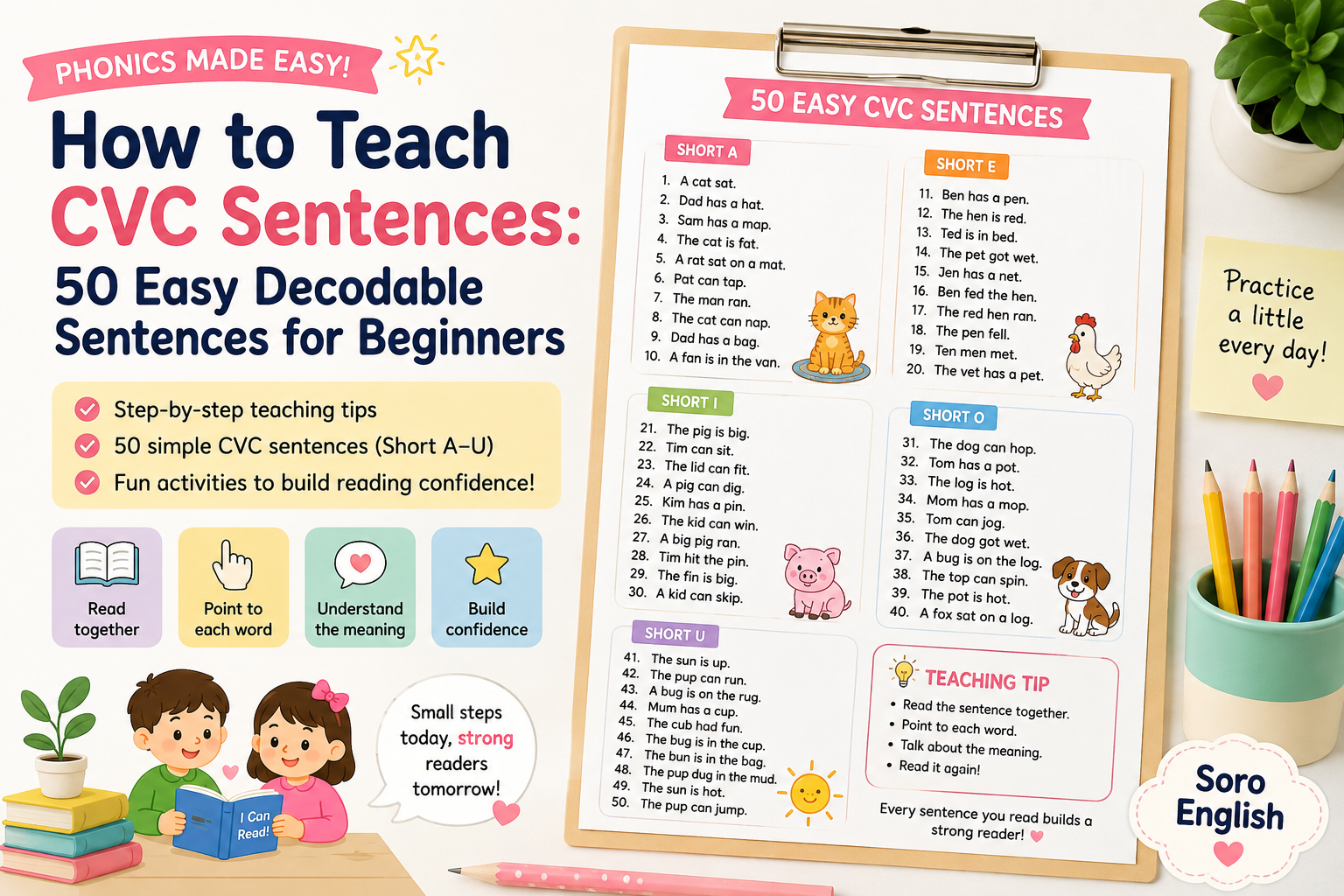
In this guide, you’ll find 50 easy CVC sentences, organized by short vowel sounds, along with practical tips to help beginning readers build confidence.
Is Your Child Ready to Read CVC Sentences?
Your child is probably ready if they can :
- Recognize most letter sounds
- Blend simple CVC words
- Read words like cat, dog, bed, pig, and sun
- Follow words from left to right
- Stay focused on a short sentence
Children do not need to master every CVC word before reading sentences.
Learning both skills together often helps build reading confidence.
Why Reading Sentences Is Different
Reading one word is only the beginning.
When children read a sentence, they also learn to:
- Track words from left to right
- Notice spaces between words
- Remember previous words
- Recognize common sight words
- Understand the meaning of the sentence
These are new reading skills that develop with practice.
Short A CVC Sentences
- A cat sat.
- Dad has a hat.
- Sam has a map.
- The cat is fat.
- A rat sat on a mat.
- Pat can tap.
- The man ran.
- The cat can nap.
- Dad has a bag.
- A fan is in the van
Short E CVC Sentences
11. Ben has a pen.
12. The hen is red.
13. Ted is in bed.
14. The pet got wet.
15. Jen has a net.
16. Ben fed the hen.
17. The red hen ran.
18. The pen fell.
19. Ten men met.
20. The vet has a pet.
Short I CVC Sentences
21. The pig is big.
22. Tim can sit.
23. The lid can fit.
24. A pig can dig.
25. Kim has a pin.
26. The kid can win.
27. A big pig ran.
28. Tim hit the pin.
29. The fin is big.
30. A kid can skip.
Short O CVC Sentences
31. The dog can hop.
32. Tom has a pot.
33. The log is hot.
34. Mom has a mop.
35. Tom can jog.
36. The dog got wet.
37. A bug is on the log.
38. The top can spin.
39. The pot is hot.
40. A fox sat on a log.
Short U CVC Sentences
41. The sun is up.
42. The pup can run.
43. A bug is on the rug.
44. Mum has a cup.
45. The cub had fun.
46. The bug is in the cup.
47. The bun is in the beg.
48. The pup dug in the mud.
49. The sun is hot.
50. The pup can jump.
How to Teach CVC Sentences
Step 1: Read the CVC Words First
Before reading the whole sentence, ask your child to read the important CVC words.
Example:
The pig is big.
Read:
Pig
Big
First.
This makes the complete sentence much easier to read.
Step 2: Read in Small Chunks
Instead of reading one word at a time, divide the sentence into short phrases.
Example:
The pig / is big.
This helps children read more smoothly.
Step 3: Read the Whole Sentence Again
Once your child finishes reading, ask them to read the sentence one more time.
The second reading is usually much smoother than the first.
Five Fun Sentence Activities
1. Finger Tracking
Point to each word while reading.
2. Read and Draw
Read:
A cat sat on a mat.
Then draw the picture.
3. Act it out
Read:
The dog can hop.
Pretend to hop like the dog.
4. Mix the Sentences
Cut the sentence into word cards.
Example:
Cat | sat | A | mat | on | a
Ask your children to rebuild the sentence.
5. Ask Simple Questions
After reading:
The pig is big.
Ask:
- Who is big?
- What animal do you see?
This helps children think about meaning while reading.
Teacher’s Tip
Many parents think their child isn’t ready because they still read slowly.
In reality, slow reading is perfectly normal for beginning readers.
Accuracy is much more important than speed.
If your child can slowly read:
The cat is fat.
They are already developing the skills needed for fluent reading.
Give them time.
Confidence grows one successful sentence at a time.
Common Mistakes
Avoid these common mistakes:
- Moving to long stories too quickly
- Correcting every small mistake immediately
- Teaching too many new sight words at once
- Practicing for long periods without breaks
Short, enjoyable practice sessions are usually much more effective.
Frequently Asked Questions
How many sentences should my child read each day?
Five to ten sentences are usually enough for beginning readers.
Should I help with sight words?
Yes.
Words like the, is, has, and a often appear in beginner books.
Help your child with these words while encouraging them to sound out the CVC words independently.
What comes after CVC sentences?
Once your child reads CVC sentences comfortably, move on to:
- Word Families
- Decodable Stories
- Consonant Blends
- Digraphs
- Long Vowel Patterns
Keep reviewing previously learned words while introducing new reading skills.
Final Thoughts
Learning to read is about much more than recognizing individual words.
Children become confident readers when they can connect words, understand sentences, and enjoy reading.
Start with just a few simple sentences each day.
Celebrate every success, no matter how small.
Today’s “A cat sat.” becomes tomorrow’s storybook.
Happy Reading!
-Soro English