Once your child can read simple CVC words and short sentences, you may start wondering :
What should we read next?
This is a great time to introduce short decodable stories.
Reading individual words such as cat, dog, pig, bed, and sun is an important first step. But beginning readers also need practice putting those words together, following a story from one sentence to the next, and thinking about what they have read.
That’s where CVC mini stories can help.
The 10 short stories below are designed for children who are beginning to move from individual CVC words and simple sentences towards connected reading.
Each story is short enough to feel manageable while still giving children a chance to practise decoding, build fluency and understand meaning.
What Are CVC Mini Stories?

CVC mini stories are very short reading passages built around simple phonics patterns.
CVC stands for :
Consonant – vowel – consonant
Examples include :
Cat
Bed
Pig
Dog
Sun
In a mini story, children see familiar words used in connected sentences rather than practising them in isolation.
For example:
Sam has a cat.
The cat is fat.
The cat can run.
Sam is glad.
This may look simple to an adult, but for a beginning reader, it is a big step.
The child is no longer decoding just one word. They are learning to read across a sentence, remember what they have read and follow an idea from one sentence to the next.
Is My child Ready for CVC Stories?
Your child may be ready if they can already:
- Recognise most common letter sounds
- Blend simple CVC words
- Read several short-vowel words independently
- Read short sentences such as “The cat is big.”
- Track words from left to right
- Recognise a few common high-frequency words
Your child does not need to read quickly.
Slow,careful decoding is completely appropriate at this stage.
If your child still needs lots of help blending individual words, spend a little more time practising CVC words and short sentences before moving on.
How to Use These CVC Stories
You don’t need to turn reading practice into a long lesson.
Five or ten minutes is plenty for many beginning readers.
Before reading a story, look at two or three words your child may find tricky.
If your child gets stuck on a decodable word, encourage them to look at each sound and blend the sounds together.
Afterwards, ask-one or two simple questions about the story.
Most importantly, give your child a chance to read the story again.
A familiar story often feels much easier the second or third time, and rereading can help build confidence and fluency.
10 Easy CVC Mini Stories
*printable CVC stories
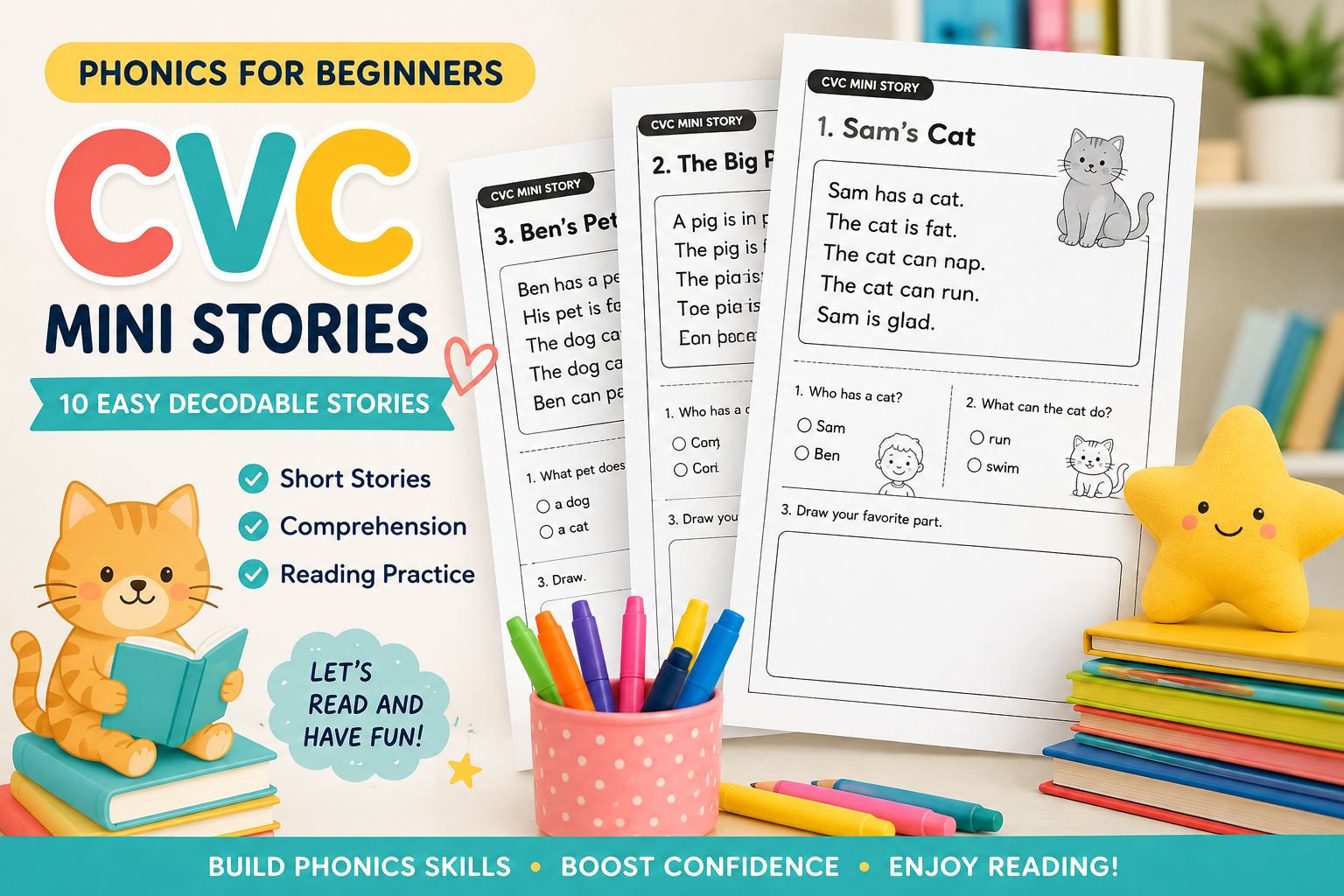
Story 1: Sam’s cat
Sam has a cat.
The cat is fat.
The cat can nap.
The cat can run.
Sam is glad.
Quick Check
Who has a cat?
□ Sam
□ Ben
What can the cat do?
□ run
□ swim
Talk about it:
What do you think Sam’s cat looks like?
Story 2: The Big Pig
A pig is in the mud.
The pig is big.
The pig can dig.
It can run.
The pig has fun.
Quick Check
Where is the pig?
□ in the mud
□ on a bed
What can the pig do?
□ fly
□ dig
Try this :
Draw the pig playing in the mud.
Story 3 : Ben’s Pet
Ben has a pet.
His pet is a dog.
The dog can sit.
The dog can run.
Ben can pat his dog.
Quick Check
What pet does Ben have?
□ a dog
□ a cat
What can the dog do?
□ sit
□ hop on a log
Story 4 : Red Hen
The hen is red.
The hen can run.
The egg is in the nest.
The hen sits on it.
Quick Check
What colour is the hen?
□ blue
□ red
Where is the egg?
□ in a bag
□ in the nest
Story 5 : The Hot Sun
The sun is hot.
A pup is in the sun.
The pup can run.
The pup can dig.
Now the pup needs a rest.
Quick Check
What is hot?
□ the sun
□ the pup
What can the pup do?
□ run and dig
□ fly and swim
Story 6 : The Bug on the Rug
A bug is on the rug.
The bug is small.
The bug can run.
It runs to the cup.
Now the bug is by the cup.
Quick Check
Where is the bug at the beginning?
□ in a box
□ on the rug
Where does it go?
□ to the cup
□ to the bed
Story 7 : Tom’s Hat
Tom has a hat.
The hat is red.
Tom puts it on.
The hat is big.
Tom grins.
Quick Check
What does Tom have?
□ a hat
□ a bag
What colour is it?
□ red
□ green
Story 8 : A Fox on a Log
A fox can run.
The fox sees a log.
It hops on the log.
The fox sits on top.
Then it hops off.
Quick Check
What does the fox see?
□ a pig
□ a log
Where does the fox sit?
□ in the mud
□ on the log
Story 9 : Kim and The Kit
Kim has a little kit.
The kit can sit.
The kit can run.
Kim gives it a pat.
The kit is glad.
Quick Check
Who has the kit?
□ Sam
□ Kim
What can the kit do?
□ sit and run
□ swim and fly
Vocabulary Note
A kit is a baby animal. A baby fox, for example, can be called a kit.
Story 10 : Dad’s Map
Dad has a map.
The map is in his bag.
Dad gets the map.
He looks at it.
Now Dad knows where to go.
Quick Check
What does Dad have?
□ a map
□ a hat
Where was the map?
□ in his bag
□ on a log
Try the Three-Read Routine
One of the simpleset ways to use these stories is to read the same story more than once.
First Read – Decode
Let your child work through unfamiliar words carefully.
Accuracy matters more than speed.
Second Read – Read More Smoothly
Read the same story again.
Your child will probably recognise more words this time.
Third Read – Think About Meaning
After the final reading, talk about what happened.
Try questions such as :
Who was in the story?
What happened first?
What happened at the end?
What was your favourite part?
This keeps comprehension at the heart of reading practice.
What If My Child Gets Stuck?
Tty not to jump in with the answer immediately.
Give your child a few seconds to look at the word.
For a simple decodable word such as pig, you might point to the letters and encourage :
/p/ /i/ /g/ – pig
If the word contains a spelling pattern your child has not learnt yet, simply tell them the word and continue reading.
The goal isn’t to make children struggle through patterns they haven’t been taught.
The goal is to help them use the phonics knowledge they already have successfully.
Don’t Forget Meaning
Beginning reading practice can easily become all about sounding out words.
But decoding is only part of reading.
For example, after reading:
The pig is in the mud.
You could ask :
Where is the pig?
Or:
Why do you think the pig likes the mud?
Questions don’t need to feel like a test. A quick conversation is often enough.
A Simple 10 – Minute Reading Routine.
You can use these stories at home or in the classroom without preparing a full lesson.
2 minutes: Review a few CVC words.
3 minutes: Read one mini story.
2 minutes: Read it again.
2 minutes: Answer the comprehension questions.
1 minute: Draw or talk about the story.
That’s it.
Short, regular reading sessions are often easier for young children than long periods of practice.
More Reading More Fun
Try changing the activity from day to day.
Children can:
- Draw their favourite part of the story
- Circle all the CVC words they can read
- Find words with the same vowel sound
- Act out the story
- Choose their favourite character
- Read the story to a toy
- Retell the story in their own words
You don’t need to use every activity.
Choose one that suits your child that day.
CVC Stories and High – Frequency Words
You mat notice that these stories contain words such as:
The, is, a , has, his, it, and he.
Not every word in an early reading passage will necessarily follow the CVC pattern being practised.
If your child hasn’t learnt one of these words yet, help them with it.
Keep the main decoding practice focused on the phonics patterns your child already knows.
Frequently Asked Questions
What age are CVC Stories for?
There isn’t one correct age. Children develop reading skills at different times.
These stories are designed for beginning readers who have already learnt basic letter sounds and are starting to blend CVC words.
Should children read CVC words before reading stories?
Usually, yes.
Children will find these stories much easier if they can already blend simple words such as cat, bed, pig, dog, and sun.
However, they don’t need to master every CVC word before trying a short story.
How many stories should my child read each day?
One story can be enough.
Rather than rushing through several new stories, try reading one story two or three times,
Rereading familiar text can help children become more accurate and confident.
Should I correct every mistake?
Not necessarily.
If the mistake changes the word or meaning, gently encourage your child to look again.
But avoid interrupting so often that reading becomes frustrating.
Keep the experience positive while still helping your child pay attention to the letters on the page.
What Should We Learn Next?
Once your child is comfortable reading CVC words, sentences and mini stories, you can gradually introduce new phonics patterns.
Good next steps include:
Word families
consonant blends
Digraphs such as sh, ch and th
Long vowel patterns
Simple reading comprehension
There’s no need to rush.
Strong early reading skills are built through lots of successful practice with material children can actually read.
Final Thoughts
Moving from single words to a whole story is an exciting milestone for a beginning reader.
The stories don’t need to be long.
In fact, a five- sentence story that your child can read successfully can be fat more valuable than a full page that feels overwhelming.
Start small.
Read together.
Read it again.
Talk about what happened.
And when your child finishes a story independently, celebrate it.
That little moment of “ I can read this!” is exactly what we’re working towards.
Happy reading!
-Soro English