Your child can read :
cat, ship, frog
and maybe even :
Cake, kite, hope
Then one day, they come across a word like :
Rain
They look for the silent e.
There isn’t one.
Then they see:
play
feet
team
boat
And suddenly, long vowel sounds seem to be everywhere.
This is usually the point when parents ask me:
“What should I teach after silent e?”
One helpful next step is introducing vowel teams.
But I wouldn’t teach every vowel team at once.
There are simply too many patterns, and for a beginning reader, a page filled with ai, ay, ee, ea, oa, ow, ie, igh, ue can quickly become overwhelming.
Instead, I like to start with a few common patterns, compare them in real words and give children time to notice where they appear.
Today, we’ll begin with:
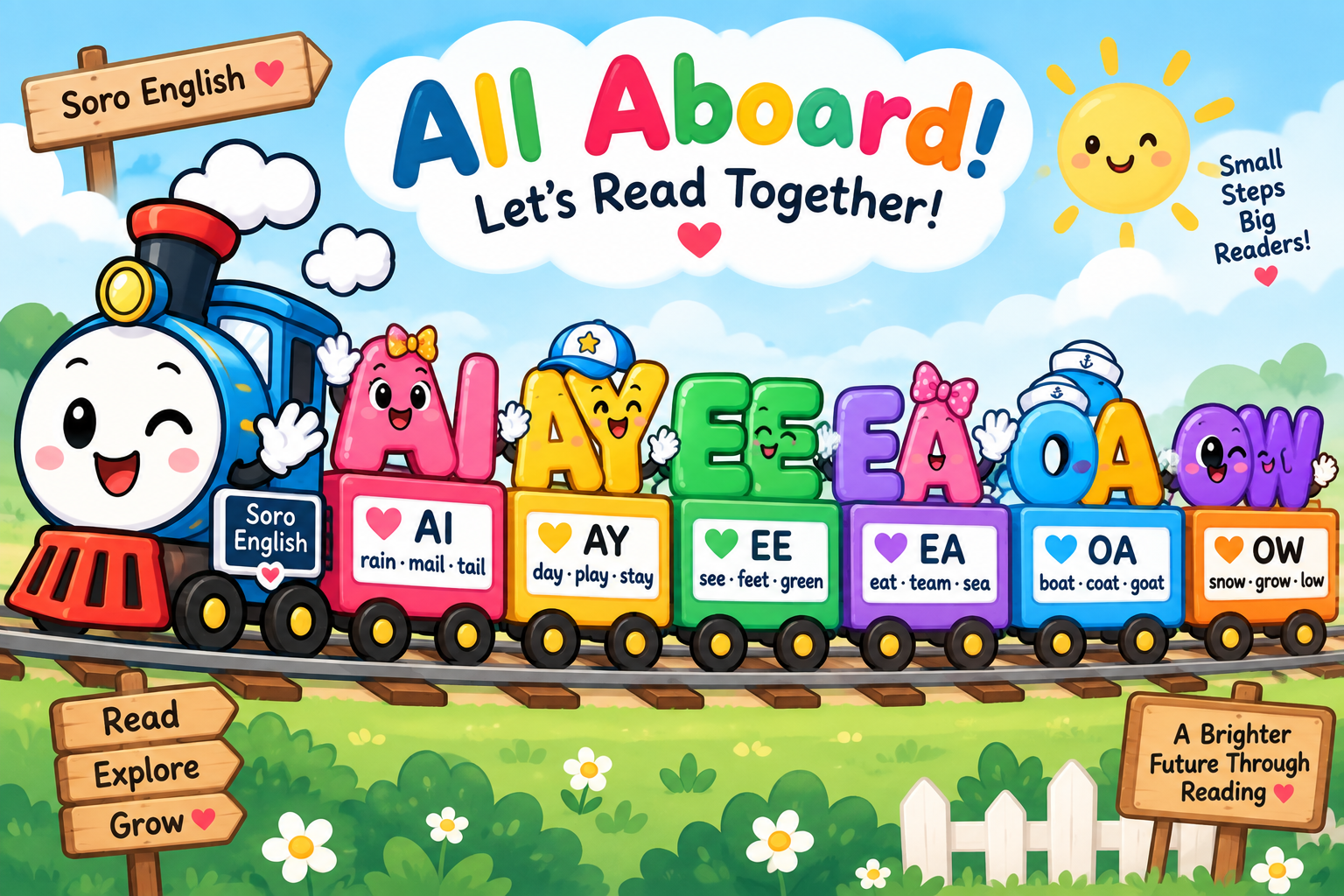
AI, AY, EE, EA, OA, OW
Let’s make them feel a little less complicated.
What is Vowel Team?
A vowel team is a spelling pattern in which vowels work together in a word.
Look at:
rain
The letters ai work together in this word.
Now look at:
boat
Here we have:
oa
And in:
feet
We see:
ee
Beginning readers don’t need a complicated definition.
I usually say something like:
“Sometimes vowels have a partner.”
Then we look at the word together.
That simple idea is enough to get started.
When should I Teach Vowel Teams?
Before introducing vowel teams, I like children to have some experience with:
Short vowels
CVC words
Consonant blends
Digraphs
and common silent-e words
For example, your child may already be able to read:
Cat
frog
ship
cake
kite
hope
They don’t need to read every word perfectly.
But if short-vowel words are still very difficult, I would spend more time there before introducing several new vowel spellings.
Phonics isn’t a race.
A strong foundation usually makes the next step much easier.
Start With What Your Child Already Knows
Before teaching ai, I might write:
Cake
And
Rain
Both words can contain the long A sound, but the spelling isn’t the same.
Then I say:
“We already know one way to spell this vowel sound. Today we’re going to find another.”
This is important.
I don’t want children to feel as though every phonics lesson introduces a completely unrelated rule.
I want them to see that they’re adding another piece to something they already know.
1.Teaching AI
Start with :
AI
Try a few familiar words :
rain
tail
wait
paint
Don’t start with twenty words.
Three or four can be enough for the first lesson.
Point to ai in each word.
r-ai- n
m-ai-l
t-ai-l
Then ask :
“Where do you see AI?”
Children begin to notice that ai often appears inside a word rather than at the very end.
That’s a useful pattern to notice.
2.Teaching AY
Now compare :
rain
and
day
Both can have the long A sound.
But look at the spelling.
rain ➡️ ai
day ➡️ ay
Try :
day
play
stay
may
say
Ask :
“Where do you see AY?”
In these examples, ay appears at the end.
Now put the two patterns next to each other :
AI
rain
tail
AY
day
play
stay
Instead of saying :
“Memorise this rule.”
I ask :
“What do you notice?”
Let the child look.
Let them think.
When children discover a pattern themselves, they’ve often more likely to remember it.
AI or AY ? Try This Simple Trick
Here’s a child-friendly starting point :
AI likes the middle.
AY likes the end.
For example :
rain
but :
day
play
This isn’t rule that explains every English word,and I don’t present it that way.
I simply use it as a useful pattern for beginning readers.
English always has surprises.
We’re just giving children a good place to start.
3.Teaching EE
Next, introduce :
EE
Try :
see
feet
seed
green
sleep
Ask your child to find ee.
Then read each word slowly.
You can also contrast :
bed
and
seed
The words aren’t a perfect pair, but they help children listen to the difference between a short vowel and a long vowel.
4.Teaching EA
Now we reach a pattern that deserves a little care.
Try these beginner-friendly examples :
eat
sea
team
meat
seat
In these words, ea represents the long E sound.
Put ee and ea next to each other :
EE
feet
green
see
EA
eat
team
sea
Ask :
“Do they sound similar?”
Yes.
“Are they spelled the same?”
No.
This is an important reading lesson:
One sound can have more than one spelling.
But EA Doesn’t Always Sound the Same
Eventually, children will meet words such as :
bread
head
and
great
That’s why I don’t tell children :
“EA always says long E.”
It doesn’t.
For the first lesson, I choose words where ea represents the target sound and say :
“EA can represent this sound in words like them and sea.”
Later, we can learn its other patterns.
A simple explanation that is accurate is better than a catchy rule we have to undo later.
5.Teaching OA
Now try :
OA
Start with :
boat
coat
road
goat
soap
Ask your child to circle oa.
Then read:
boat
coat
goat
I like these words because the spelling pattern is easy to see.
6.Teaching OW
Next, compare :
boat
and
snow
In these examples, both contain the long O sound, but the spelling is different.
Try :
snow
grow
low
row
Then compare :
OA
boat
coat
road
OW
snow
grow
low
Again, ask :
“What do you notice?”
In these examples, oa is inside the word while ow comes at the end.
Children don’t need a lecture.
A few well-chosen words can show the pattern beautifully.
But Wait – OW Has Another Sound!
Here’s another English surprise.
Look at :
snow
and
cow
Same letters.
Different vowel sounds.
This is exactly why I try not to tell children :
“OW always says…”
Instead :
“In snow, OW represents this sound.”
Later, when we meet cow, we learn another sound that the spelling ow can represent.
Beginning phonics rules should help children read.
They shouldn’t create confusion later.
My Favorite Way to Teach Vowel Teams
I use four simple steps.
1.See it
Show the pattern.
ai
2.Hear it
Read a word.
rain
3.Compare it
Put two spellings together.
rain / day
4.Use it
Read a sentence.
It may rain today.
That’s it.
Children don’t need to copy twenty words to learn a spelling pattern.
They need repeated opportunities to see it, hear it and use it.
Try the Vowel Team Detective Game
Write :
rain
play
feet
team
boat
snow
Tell your child :
“You’re the Vowel Team Detective today.”
Then give them mission.
Find AI.
Find AY.
Find EE.
Find EA.
Find OA.
Find OW.
Let them circle the vowel teams with a pencil or highlighter.
Then read every word together.
Simple activities like this work because the child has a reason to look closely at the letters.
Which Vowel Team Is Missing?
Try :
r______n
pl_____
f_____t
t_____m
b_____t
sn_____
Give your child :
ai, ay, ee, ea, oa, ow
Then let them complete the words.
Afterwards, don’t stop at spelling.
Read each completed word aloud.
Sort the Vowel Teams
Give your child these words :
rain, play, feet, team, boat, snow, mail, day, green, sea, goat, grow
Then sort them.
AI
rain
AY
play
day
EE
feet
green
EA
team
sea
OA
boat
goat
OW
snow
grow
Sorting helps children look beyond the meaning of a word and notice its spelling structure.
Move From Words to Sentences
Once your child can read several words, use them in short sentences.
It may rain.
We can play.
I can see green.
The team can run.
The goat is on the road.
I see snow.
After each sentence, ask one small question.
What may happen?
What colour can you see?
Where is the goat?
Now we’re connecting phonics with comprehension.
That’s always the goal.
Read and Draw
One of my favourite low-preparation activities is Read and Draw.
Try :
The green boat is on the sea.
Ask your child to read it.
Then draw it.
Or :
The goat is in the rain.
Read.
Think.
Draw.
The picture gives you a simple way to see whether your child understood the sentence.
It also gives children a little break from circling and writing.
What If My Child Keeps Mixing Up AI and AY?
Don’t give them another long list.
Put just two words next to each other :
rain
day
Circle :
ai
and :
ay
Ask:
“Where is AI?”
Middle.
“Where is AY?”
End.
Then try :
mail / play
and :
tail / stay
A small contrast is often much easier to remember than a full worksheet of rules.
What If My Child Mixes Up EE and EA?
This is different.
Both spellings can represent a similar vowel sound, so the child can’t always choose the correct spelling simply by listening.
For reading practice, focus first on recognising both patterns:
feet
team
Later, spelling practice can help children remember which words use ee and which use ea.
Reading and spelling are connected, but they aren’t exactly the same skill.
That’s an important distinction for parents to know.
Don’t Ask Children to Guess From Pictures
If we’re practising the word:
goat
I want the child looking at :
g-oa-t
not simply looking at a picture and guessing goat.
Pictures are wonderful after reading.
They help with meaning, vocabulary and enjoyment.
But when we’re practising decoding, the letters should give us the word.
This is something I come back to again and again when teaching beginning readers.
A 10-Minute Vowel Team Routine
You don’t need a long lesson.
2 minutes – Review
Read three familiar silent-e words.
cake, kite, hope
2 minutes – Introduce
Show :
ai
Read :
rain
2 minutes – Compare
rain / day
2 minutes – Play
Find ai and ay words.
2 minutes – Read
Finish with:
It may rain today.
Then stop.
Tomorrow, review before adding something new.
Short, successful practice is often more useful than pushing through a long lesson when a child is tired.
A Beginner Vowel Team Word List
Here’s a simple list to keep nearby.
AI – rain, mail, tail, wait, paint
AY – day, play, stay, may, say
EE – see, feet, seed, green, sleep
EA – eat, sea, team, meat, seat
OA – boat, coat, road, goat, soap
OW – snow, grow, low, row
Don’t feel that your child needs to master this whole table at once.
Choose one pair of patterns and stay there until it feels familiar.
From Vowel Teams to a Mini Story
When individual words are becoming easier, move into connected reading.
A Rainy Day
It may rain today.
Jay has to stay in.
He can see the rain.
Then the rain stops.
Jay goes out to play.
He sees a snail on the road.
“Hi, snail!” says Jay.
Jay has a great day.
After reading, ask :
Why does Jay stay in?
What does Jay do when the rain stops?
What does he see?
Now the child isn’t simply finding ai and ay.
They’re reading a story.
That’s where phonics starts turning into real reading.
Free Vowel Team Worksheets for Beginners
If your child needs more practice, printable activities can help reinforce the patterns without turning every lesson into another word list.
Download the Free Vowel Team Worksheets
I recommend doing just one or two pages at a time.
The goal isn’t to finish a workbook.
The goal is for your child look at a new word and have an idea of what to try.
Frequently Asked Questions
About Vowel Teams
What are vowel teams?
Vowel teams are spelling patterns involving vowels working together in words. Examples include ai in rain, ee in feet and oa in boat.
Which vowel teams should I teach first?
There isn’t one sequence that works for every child. I like to begin with common, easy-to-compare patterns such as ai/ay, ee/ea and oa/ow, introducing only a small number at a time.
How do I teach AI and AY ?
Start with contrasting examples such as rain/day and mail/play. Help your child notice where each spelling appears in these words rather than asking them to memorise a long rule.
Why can EA make different sounds?
English spelling patterns don’t always represent only one sound. For beginners, start with clear long-E examples such as team, sea and eat, then introduce other EA pronunciations later.
Are vowel teams the same the same as digraphs?
Both involve letters working together, but vowel teams specifically involve vowel spelling patterns. Children who already understand consonant digraphs can often use that idea as a bridge to learning vowel teams.
Should my child memorise vowel-team words?
I wouldn’t rely on memorising whole word lists. Help children notice the spelling pattern, decode the word, read it repeatedly and then meet it again in sentences and stories.
What should children learn after vowel teams?
Once common vowel teams become familiar, children can continue with additional long-vowel patterns and increasingly complex decodable reading.
What Comes Next?
Look how far your beginning reader has come :
Letter Sounds
⬇️
Short Vowels
⬇️
CVC Words
⬇️
Consonant Blends
⬇️
Digraphs
⬇️
Silent E
⬇️
Vowel Teams
But knowing phonics patterns isn’t quite the same as reading smoothly.
A child may be able to sound out every word and still read like this :
The … goat … is … on … the … road.
So our next step isn’t simply another list of phonics rules.
It’s learning how to turn accurate decoding into smoother reading.
In the next Soro English lesson, we’ll explore :
Reading Fluency for Beginners :
How to Help Kids Read Smoothly and Confidently
We’ll look at simple ways to practise repeated reading, phrasing and short decodable passages without pressuring children to read faster.
Final Thoughts
Vowel teams can look complicated when they’re all displayed on one phonics chart.
ai, ay, ee, ea, oa, ow …
That’s a lot for a beginning reader.
So I don’t start with the chart.
I start with two words.
rain
day
We read them.
We compare them.
We notice what’s the same and what’s different.
Then we try another pair.
Little by little, children begin to see that English spelling isn’t a random collection of letters.
There are patterns they can look for.
Patterns they can test.
Patterns that can help them when they meet a word they’ve never seen before.
For me, that’s much more valuable than a child memorising another list.
I want them to become the kind of reader who looks carefully, thinks for a moment and says :
“I know what I can try.”
And every time that happens, they’re becoming a little more independent as a reader.
Happy reading!😃
-Soro English