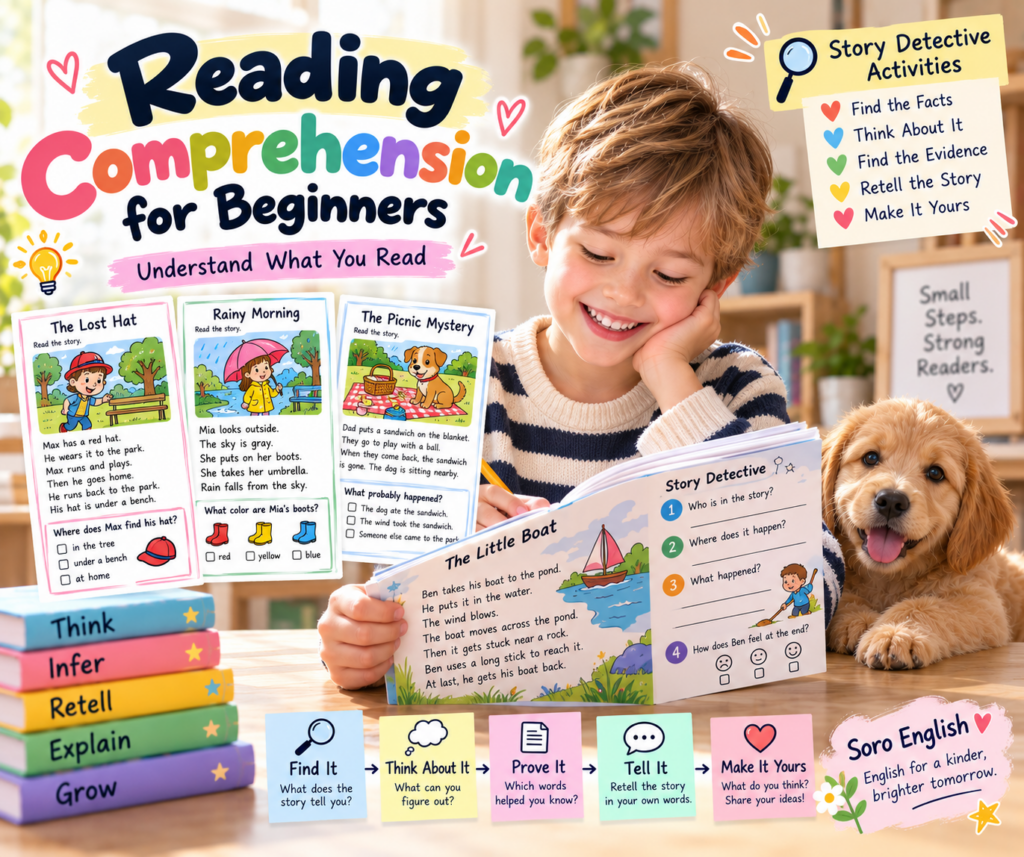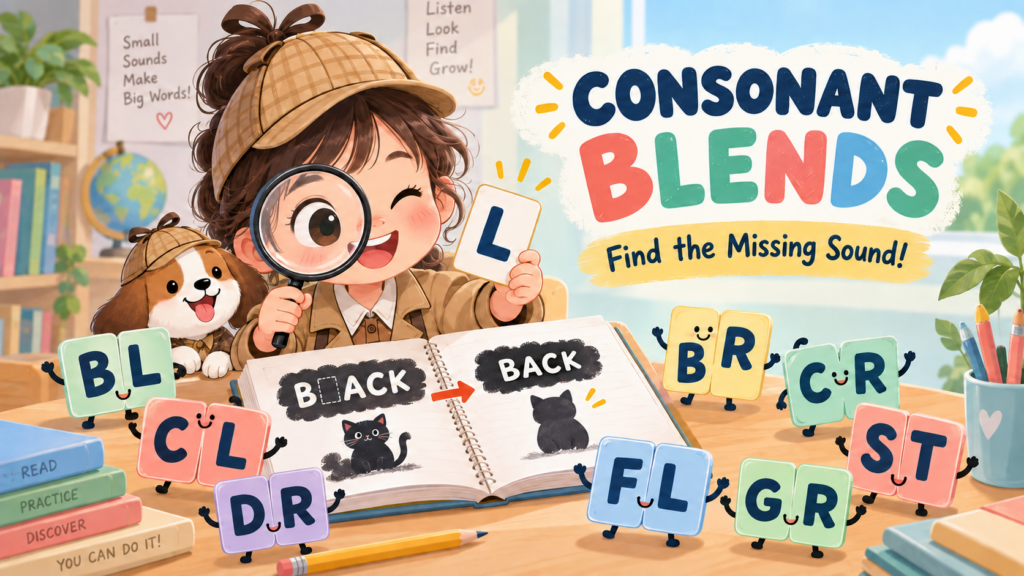
cat
One word.
Then :
The cat sat.
Three words.;
And then, one day
The cat sat on a mat.
A bug was on the mat.
The cat saw the bug.
The bug ran.
The cat ran too.
Something has changed.
We’re not reading a word list anymore.
We’re reading a story.
It may be only five lines long.
There may be no dragons, magical castles or exciting mysteries.
But for a child who has spent weeks learning letter sounds, blending CVC words, meeting digraphs and discovering vowel teams, those five little lines can feel enormous.
Because this time, someone else isn’t reading the story to them.
They are reading it themselves.
And I think that’s one of the most important moments in learning to read.
Today, we’re going to help children get there with decodable reading passages for beginners.
Not by guessing from pictures.
Not by memorizing sentences.
And definitely not by racing through a page.
We’re going to use something children already have :
the phonics they have learned.
What Is a Decodable Reading Passage?
The word decodable can sound more complicated than it really is.
Here’s how I explain it to parents.
A decodable passage is a short text designed so that children can read much of it using phonics patterns they have already learned.
For example, imagine your child has learned short vowel CVC words.
A beginner passage might contain :
Sam has a red bag.
The bag is big.
Sam can put a map in the bag
The child can use familiar sound-spelling relationships to work through words such as :
Sam
red
bag
big
map
That’s very different from giving a beginning reader a page full of spelling patterns they haven’t learned yet.
Decodable reading gives children an opportunity to say :
“I know what to do with this word.”
And that’s exactly what I want.
A Small Rule I Use : Don’t Make the Picture Do the Reading
Imagine this sentence :
The cat is on the mat
There’s big picture of a cat sitting on a mat beside it.
The child reaches the word cat, looks at the picture and says :
“Cat!”
It might look like reading.
But I always wonder :
Did the child read the word – or read the picture?
Pictures are wonderful.
I love them in children’s books.
They build vocabulary, imagination and comprehension.
But when we’re specifically practising decoding, I want children to look at the letters first.
So when a child gets stuck, instead of saying :
“Look at the picture. What could it be?”
I prefer :
“Look at the word. What do you notice?”
Maybe they notice :
sh
or :
oa
or :
a_e
That’s the habit I want to build.
Letters first. Meaning next. Pictures last
That’s one of my favourite little rules for beginner reading practice.
Is Your Child Ready for Decodable Passages?
You don’t have to wait until your child knows every phonics rule in English.
They don’t.
But before moving into short passages, I like children to have some experience with :
- Common letter sounds
- blending simple words
- short vowel CVC words
- at least a small bank of familiar high-frequency words
If your child has already worked through consonant blends, digraphs, silent E or vowel teams, you can gradually choose passages containing those patterns too.
The important part is matching the passage to what the child has actually learned.
A passage isn’t useful simply because someone labeled it “beginner.”
It needs to be readable for your beginner.
Start Smaller Than You Think
When parents hear “reading passage”, they sometimes imagine a whole page.
I don’t.
For a new reader, this can be a passage :
A cat sat.
The cat ran.
The cat is back.
That’s enough.
Three sentences.
One tiny event.
A beginning.
A middle.
An end.
And most importantly :
The child can read it.
I would rather give a child three sentences they can genuinely decode than a beautiful page that requires an adult to rescue them every few words.
Success matters.
Especially at the beginning.
The Soro English 4-step Reading RoutineE
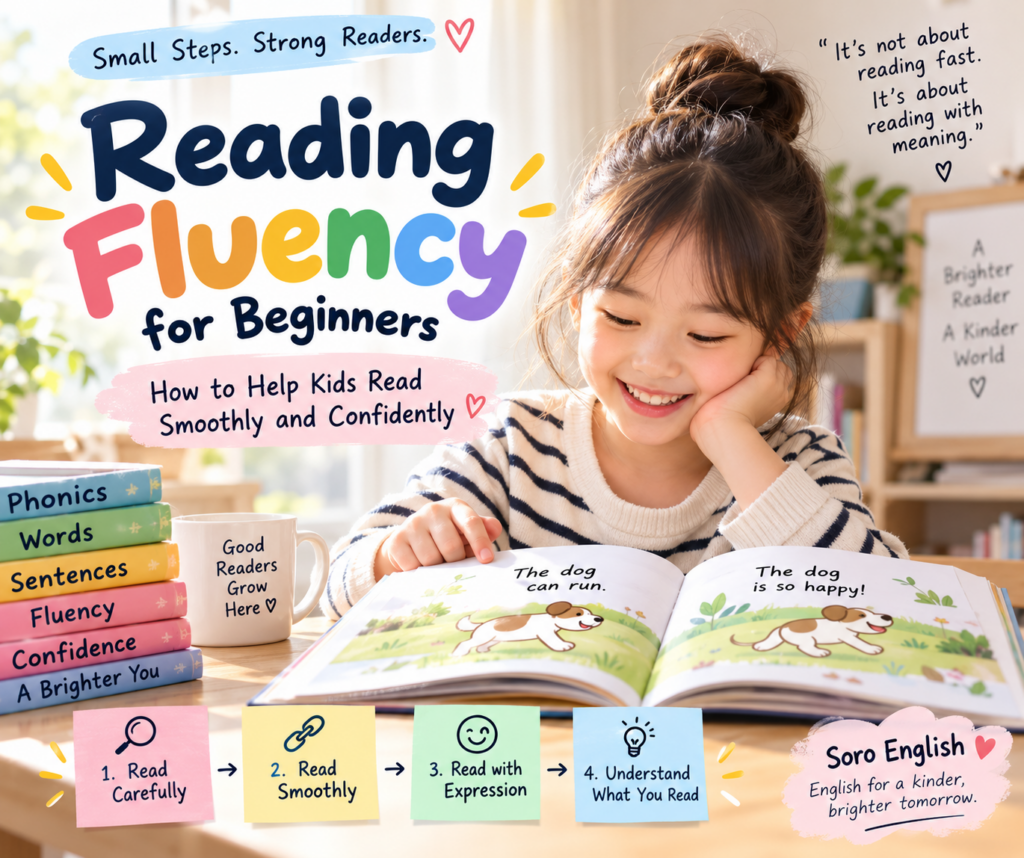
For our Reading Fluency practice, we used the idea :
Read Carefully ➡️ Read Smoothly ➡️ Read with Expression ➡️ Understand
Because children don’t need a completely new routine every time we introduce a new skill.
They need familiar steps that gradually become habits.
So for each decodable passage, try this.
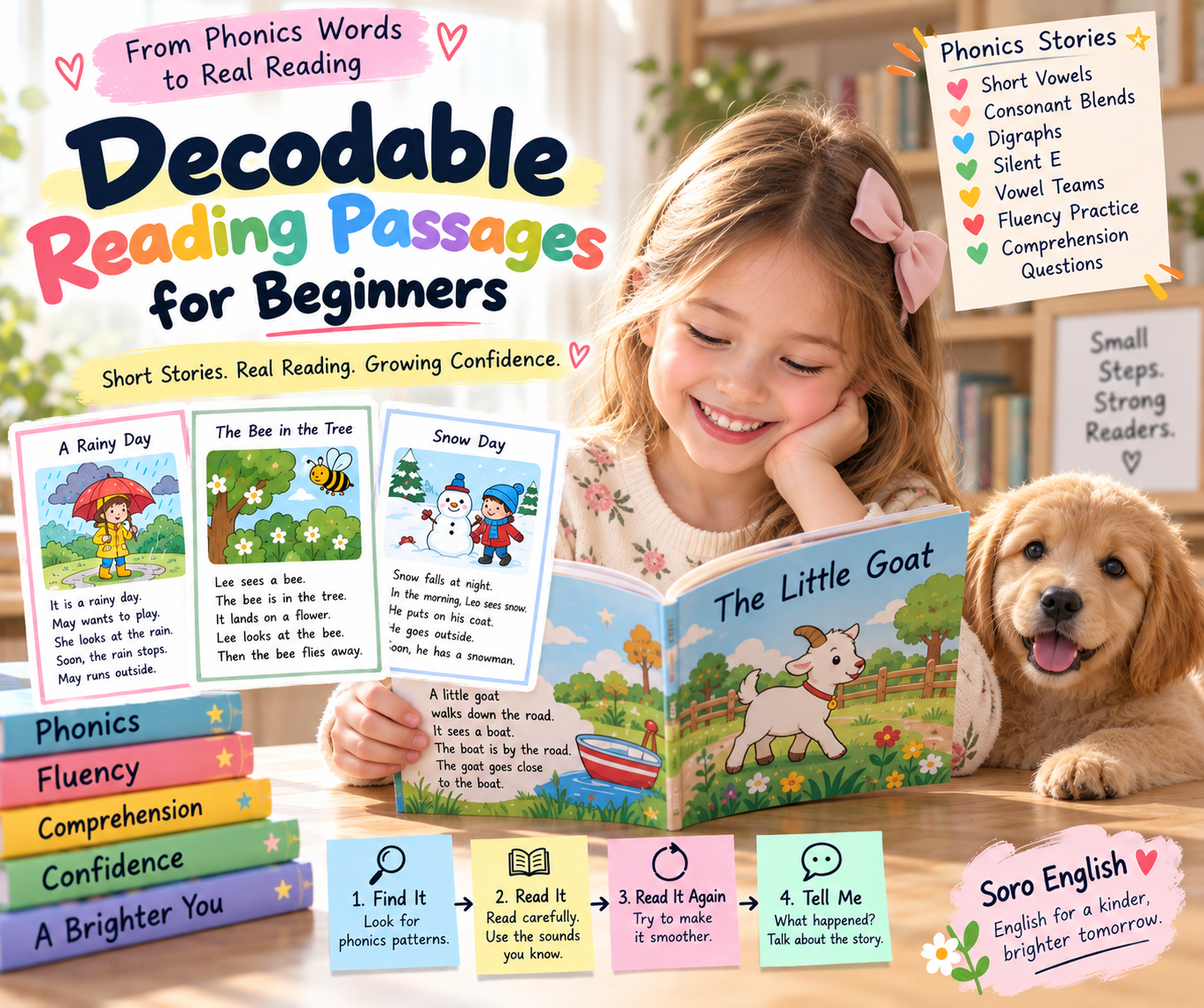
1.Find it 🔎
Before reading, look for familiar phonics patterns.
Maybe :
sh
ch
ai
ee
oa
Circle or underline them.
2. Read it 📖
Read the passage carefully.
Don’t worry about speed.
If a word is difficult, stop and decode it.
3. Read it Again 🔗
Now read the passage a second time.
Try to put words together more naturally.
4. Tell Me 💬
Close the page – or simple look away.
Ask :
“What happened?”
If the child can tell you in their own words, even very simply, they’re beginning to connect decoding with meaning.
That’s reading.
Decodable Passage 1 : The Cat
Phonics Focus : Short A
Look for :
Cat, sat, mat, ran, bag
The Cat and the Bag
A cat sat on a mat.
The cat saw a bag.
The cat ran to the bag.
Sam had the bag.
“Hi, cat!” said Sam.
The cat sat by Sam.
Read it
☐ Read 1 – Carefully
☐ Read 2 – Smoothly
☐ Read 3 – Like you’re telling the story
Think About It
- Where did the cat sit?
- What did the cat see?
- Who had the bag?
- Where did the cat sit at the end?
Word Detective🔎
Find and circle three words with short a.
Don’t Ask Ten Questions After Every Story
This is something I’ve learned from teaching.
Sometimes we turn a tiny reading passage into an interrogation.
A child finally finishes reading.
And immediately :
“What happened?”
“Who was there?”
“Where were they?”
“Why did he do that?”
“What happened next?”
“What was the main idea?”
The child’s face changes.
Reading suddenly feels like a test.
For beginning readers, I often start with just one question:
“Tell me what happened.”
Their answer doesn’t have to sound like a textbook answer.
If they can tell me:
“The cat found Sam’s bag.”
Great.
They understood.
Then we can go a little deeper.
Decodable Passage 2 : The Fish Shop
Phonics Focus : SH
Before reading, find :
fish, shop, dish
The Fish Shop
Josh is at a fish shop.
He sees a big fish.
The fish is in a dish.
“Can I have this fish?” asks Josh.
The shop man nods.
Josh gets the fish.
Think
Where is Josh?
What does he see?
What does Josh get?
Phonics Hunt
How many sh words can you find?
Decodable Passage 3: Chip and the Chick
Phonics Focus : CH
Chip and the Chick
Chip sees a chick.
The chick is on a bench.
“Come here, chick.” says Chip.
The chick hops down.
Chip and the chick run to the shed.
Read Again
Can you make the dialogue sound like someone is really speaking?
Can My Child Use Pictures?
“Come here, chick.”
Try it again.
That’s where decoding starts meeting fluency.
What Should I Do When My Child Gets Stuck?
This moment matters more than we sometimes realize.
The child stops at:
Ship
And looks at you.
It’s tempting to say:
“Ship.”
Problem solved.
Except the child didn’t solve it.
So I usually wait a moment.
Then I might ask:
“What do you see at the beginning?”
The child notices:
Sh
“Good. What sound?”
Then:
Sh-i-p
Finally:
Ship
That little pause gave the child a chance to do the work.
You don’t need to turn every mistake into a phonics lesson.
But whenever possible, help children find a way into the word rather than immediately handing it to them.
Decodable Passage 4: Jake’s Kite
Phonics Focus : Silent E
Before reading :
Jake, kite, ride, home
Jake’s Kite
Jake has a kite.
It is red and white.
Jake rides his bike to the park.
He flies the kite.
The kite goes up, up, up!
Jake smiles.
Then he rides home.
Find the Silent E Words
Think
How does Jake get to the park?
What does he fly?
How does Jake feel?
From “Sound It Out” to “I Know That Word”
Something interesting happens when children meet a word again and again.
The first time:
r – ai -n
They work through it.
The next time:
rain
A little faster.
Then one day they see:
rain
and simply read :
rain.
No visible sounding out.
No long pause.
That’s not a reason to stop teaching phonics.
It’s one of the reasons we teach phonics in the first place.
With successful reading experience, familiar words can become increasingly automatic.
And when fewer words require intense effort, children have more attention available for the story.
Decodable Passage 5: Rainy Day
Phonics Focus : AI & AY
Find these words before reading:
Rain, day, play, wait, may
Rainy Day
It is a rainy day.
May wants to play.
She looks at the rain.
“I can wait,”says May.
Soon, the rain stops.
May runs outside to play.
“What a fun day!”
Vowel Team Hunt
Circle AI words.
Underline AY words.
Think
Why does May wait?
What happens to the rain?
What does May do at the end?
Decodable Passage 6: The Bee
phonics Focus: EE
The Bee in the Tree
Lee sees a bee.
The bee is by a green tree.
Lee can see three flowers.
The bee lands on a flower.
“Hi, little bee.”says Lee.
Then the bee flies away.
Find the EE Words
Lee,
Tell Me
What happened in this story?
Try answering without looking back at the passage.
Decodable Passage 7: The Goat and the Boat
Phonics Focus: OA
The Goat and the Boat
A goat walks down the road.
It sees a boat.
The boat is by the road.
The goat goes close to the boat.
“No, goat!”calls Joan.
The goat stops.
Joan takes the goat home.
OA Detective🔎
Find the words containing oa.
Think
What does the goat see?
Who calls to the goat?
Where does Joan take the goat?
One Passage, Three Different Lessons
Here’s one of my favourite ways to get more from a short reading passage.
Don’t always use a new one.
Take :
The bee is by the green tree.
Day 1: Decoding
Can we read the words correctly?
Day 2: Fluency
Can we read the sentence smoothly?
Day 3: Comprehension
What is beside the tree?
Now the same sentence has helped us practise:
Phonics + fluency + comprehension
This is also why I don’t feel the need to constantly give children harder material.
Sometimes they need deeper practice, not harder practice.
Should Children Reread Decodable Passages?
Yes – but give the rereading a purpose.
Instead of:
“Read it again.”
try:
First read: Find the words.
Second read: Make it smooth.
Third read: Tell me the story.
Now each reading has a different job.
I find that children respond much better when they know why they’re reading something again.
Decodable Passage 8: Snow Day
Phonics Focus : OW – Long O
Snow Day
Snow falls at night.
In the morning, Leo sees snow.
“Look at the snow!”he says.
Leo puts on his coat.
He goes outside.
Leo rolls the snow.
Soon, he has a snowman.
Read it Three Ways
🔎 Carefully
☐
🔗 Smoothly
☐
💬 With expression
☐
Think
When does the snow fall?
What does Leo make?
But What About Words Children Can’t Decode Yet?
This is where we need some flexibility.
Natural English contains many common words that don’t fit neatly into the exact phonics pattern a child is practising.
So before reading, I sometimes introduce a few words the child may need.
For example :
Words to Know
the
was
said
you
Then we read.
I don’t want one unfamiliar high-frequency word to prevent a child from enjoying an otherwise accessible passage.
But I also don’t want half the passage to consist of words the child can’t yet decode.
That’s the balance.
A 10-Minute Decodable Reading Routine
You don’t need an hour.
Here’s a routine parents can realistically use.
Minute 1-2 — Phonics Hunt 🔎
Find today’s target pattern.
For example :
ai
Minute 3-5 — First Read 📖
Read carefully.
Help only when needed.
Minute 6-7 — Second Read 🔗
Read again more smoothly.
Minute 8-9 — Tell Me 💬
Ask :
“What happened?”
Then ask one simple comprehension question.
Minute 10 — Finish With Success ⭐
Choose one sentence the child read well.
Read it one final time.
Then stop.
Sometimes stopping at the right moment is part of a good reading lesson too.
Yes.
But think about when.
When we’re practising decoding, I like this order :
1.Look at the letters.
2.Use the phonics you know.
3.Blend the word.
4. Ask whether the word makes sense in the sentence.
5.Enjoy the picture.
Picture should add meaning and enjoyment.
They shouldn’t have to do the decoding for the child.
Try This :Cover the Picture
Here’s a simple experiment.
Choose a very short illustrated passage.
Cover the picture with a piece of paper.
Ask your child to read the sentence.
Then reveal the picture.
Say :
“Were you right?”
Children often love checking.
Now the illustration becomes a way to confirm meaning after reading, rather than a shortcut around the word.
Decodable Passage 9: A Green Seed
Phonics Focus: EE & EA
A Green Seed
Dean has a seed.
He puts the seed in the ground.
Each day, Dean gives it water.
He waits.
Soon, he sees something green.
“A leaf!” says Dean.
His little seed has begun to grow.
Word Hunt
Find :
ee :
ea:
Think
What does Dean plant?
What does he give it?
What does he see?
Decodable Passage 10: A Boat Sea
Phonics Focus: Mixed Vowel Teams
A Boat at Sea
Lee and May are on a boat.
They see the blue sea.
A bird flies over the boat.
“Look!” says May.
They see a big green tree on the land.
Soon, the boat reaches the shore.
Lee and May smile.
Find the Vowel Teams
Circle words containing:
ee
Underline words containing:
ay
Put a box around words containing:
oa
Tell the Story
Without looking at the passage, tell someone what happened.
You don’t need to remember every sentence.
Tell it in your own words.
Don’t Turn Every Reading Into a Test
This is something I want to keep reminding myself of too.
We teach because we want to know whether children are learning.
So it’s natural to check.
But children also need time simply to be readers.
Sometimes, after a passage, don’t ask five questions.
Say :
“Which part did you like?”
Or :
“Was anything funny?”
Or simply :
“Want to read another one?”
If the answer is :
“Yes!”
that’s valuable information too.
Free Decodable Reading Passages for Beginners
To make practice easier,I’ve created a printable Decodable Reading Passages for Beginners pack to use alongside this lesson.
The activities are designed to move through the same Soro English routine :
🔎 Find It
Spot the phonics pattern.
📖 Read It
Decode the passage carefully.
🔗 Read It Again
Build smoother reading.
💬 Tell Me
Talk about what happened.
The printable pack includes beginner passages focusing on:
Short Vowels
CVC Words
Consonant Blends
Digraphs
Silent E
AI & AY
EE & EA
OA & OW
Mixed Phonics Review
as well as simple comprehension questions, word hunts, rereading checkboxes and reading reflection pages.
Download the Free Decodable Reading Passages
Use one passage at a time.
There’s no need to finish several pages in one sitting.
One successful story is enough for today.
Frequently Asked Questions About Decodable Reading
What are decodable reading passages?
Decodable passages are texts designed so beginning readers can use phonics knowledge they have already learned to read much of the text.
When should children start decodable reading?
Children can begin very short decodable text once they can blend simple sounds into words. Start with just a few sentences if necessary.
Should my child sound out every word?
Not forever. Children may need to sound out unfamiliar words at first. As they repeatedly encounter words and spelling patterns, reading can become more automatic.
Should children use pictures to guess words?
Pictures are valuable for meaning and enjoyment, but during decoding practice, encourage children to examine the letters and use their phonics knowledge before relying on the illustration.
How long should a beginner reading passage be?
There’s no single ideal length. For a new reader, even three or four successful sentences can provide meaningful practice.
Should children reread the same passage?
Rereading can be useful when it has a purpose. The first reading might focus on accurate decoding, the next on smoother reading, and another on expression and understanding.
What if the passage is too difficult?
Stop and look at why.
Are there too many unfamiliar phonics patterns?
Too many unknown words?
Are the sentences too long?
Move back to an easier text.
Easier doesn’t mean going backward.
Sometimes an easier text is exactly what allows a child to practise the skill successfully.
From Reading Words to Reading Stories
Remember where we started?
Cat
Then:
The cat sat.
And finally :
The cat sat on a mat.
A bug was on the mat.
The cat saw the bug.
The bug ran.
The cat ran too.
To an adult, that’s an extremely simple story.
To a beginning reader, it can mean something completely different.
I read that.
Not Mom.
Not Dad.
Not the teacher.
Me.
And that’s why I don’t rush this stage.
We can always find a longer book.
A harder passage.
A bigger word.
But first, I want a child to experience what it feels like to look at a page and think :
“I know what I can try.”
Then :
“I can read this.”
And eventually :
“Can I read another one?”
That’s the journey we’re building at Soro English.
Not faster readers.
Not children who can finish the most worksheets.
Readers who know what to do when they meet a word – and who want to keep going when they reach the next page.
Small Steps. Strong Readers.
-Soro English