
There is something special about the first time a child reads a word on their own.
Not a word they have memorized.
Not a word they guessed from a picture.
A word they actually sounded out and read by themselves.
For many beginning readers, this moment starts with a simple three-letter word like :
Cat
A child looks at the letters, remembers the sounds, blends them together –
/k/ /æ/ /t/ → cat
-and suddenly, those three letters become a word.
This is why CVC words are such an important step in learning to read.
If your child has already started learning letter sounds and short vowel sounds, CVC words are a natural next step.
In this guide, I’ll explain what CVC words are, why they matter, and how can practice them at home without making reading feel difficult or overwhelming.
What Are CVC Words?
CVC stands for :
C – Consonant
V – Vowel
C – Consonant
In other words, a CVC word follow this pattern :
Consonant + vowel + consonant
Here are some simple examples :
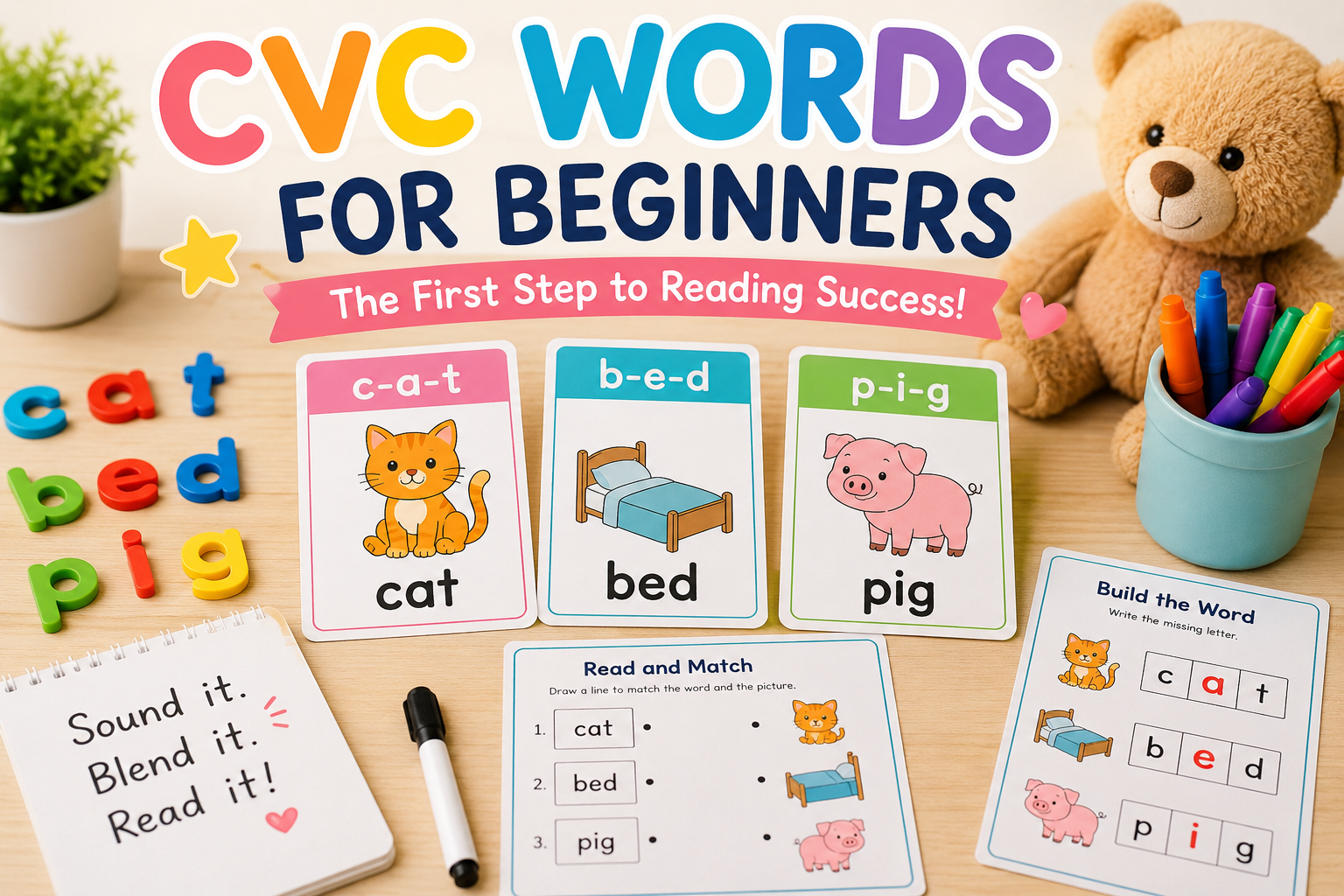
Cat
Bed
Pig
Dog
Sun
Look at the word cat.
C is a consonant.
A is a vowel.
T is a consonant.
So :
C + a + t = CVC
These short, predictable words are often among the first words children learn to decode with phonics.
Why Are CVC Words Important for Beginning Readers?
Before children can read words independently, they need to understand an important idea :
Letters represent sounds, and those sounds can be blended together to make words.
Imagine that a child has already learned these sounds :
C →/k/
A →/æ/
T →/t/
Knowing each sound separately is an important first step.
But reading begins when the child can put those sounds together :
/k/ … /æ/ … /t/
Then a little faster ;
/k/ /æ/ /t/
And finally :
Cat
That small step is actually a big one.
The child is beginning to decode rather than simply memorize words.
Once children understand how this works, they can use the same skill with many new words.
Map
/m/ /æ/ /p/ → map
Sit
/s/ /ɪ/ /t/ → sit
Dog
/d/ /ɑ/ /g/ →dog
They are beginning to discover that reading has patterns.
Start With Short Vowel CVC Words
If your child is new to CVC words, I recommend practicing one short vowel at a time.
Trying to introduce too many vowel sounds at once can make things unnecessarily confusing.
Start slowly.
Let your child become comfortable with one group before mixing different vowel sounds together.
Short A CVC Words
Start with words such as:
Cat, bat, hat, map, cap, bag, jam, fan, pan, van
You might begin with just three words:
Cat – hat – map
Point to each letter and say the sounds slowly.
For cat:
/k/ /æ/ /t/
Then blend the sounds:
Cat
Try not to rush this part.
Children often need to hear and practice the blending process many times before it becomes automatic.
Short E CVC Words
Once your child is comfortable with Short A words, you can introduce simple Short E words.
For example:
Bed, red, hen, pen, ten, net, leg, jet, web, den
Try comparing words that have similar patterns :
Hen – pen – ten
Ask your child:
“What changed?”
They may notice that the first letter changes while the rest of the word stays the same.
This is a simple way to help children begin noticing patterns in words.
Short I CVC Words
Next, try words with the short I sound:
Pig, big, sit, hit, fin, pin, lip, dig, win, zip
Take pig, for example.
Instead of saying the whole word immediately, guide your child through each sound :
P → /p/
I → /ɪ/
G →/g/
Now blend:
/p/ /ɪ/ /g/
Pig!
That final moment – when separate sounds suddenly become a word – is exactly what we want children to experience.
Short O CVC Words
Here are some beginner -friendly Short O words:
Dog, log, hot, pot, top, mop, fox, box, hop
You can also practice by changing just one letter.
For example:
hot → pot
Then
pot → cot
This helps children see that changing one sound can create a completely different word.
Short U CVC Words
Finally, practice simple Short U words :
Sun, fun, run, cup, bug, bus, mud, nut, rug, hut
Once your child can read words from each vowel group separately, begin mixing them.
For example:
Cat – pig – sun – bed – dog
Now the child has to look carefully at the middle vowel instead of relying on a repeated pattern.
What is Blending?
one of the most important skills in early phonics is blending.
Blending means putting individual sounds together to read a whole word.
For example:
M – a – p
A beginning reader might first say:
/m/ … /æ/ … /p/
Then:
/m/ /æ/ /p/
Finally :
Map
This may look simple to an adult, but it requires several skills at once.
The child has to :
Recognize the letters,
Remember their soumds,
Hold those sounds in mind,
and blend them together.
So if your child needs time, that is completely normal.
Reading is not a race.
A Simple Way to Practice CVC Words at Home
You do not need a long lesson.
For beginning readers, five to ten focused minutes can be enough.
Here is a simple routine I like to use.
- Review the vowel sound
Choose one vowel
For example:
a → /æ/
Say the sound together a few times.
2. Read three CVC words
Try:
Cat
Map
Fan
Help your child sound out each word.
3. Change one sound
Start with:
Cat
Change c to h.
Now we have:
Hat
Change h to b
Now:
Bat
Children often enjoy seeing how one small letter change creates a new word.
4. Read a short sentence
Once your child can read a few CVC words, put them into a very simple sentence.
A cat sat.
Or:
The dog is hot.
The sentence does not need to be complicated.
The goal is to help children experience the exciting transition from:
Sounds →words → sentences
Should Children Memorize CVC Words?
This is an important question.
It is natural for children to remember words after seeing them many times.
But when teaching phonics, the goal should not be to make children memorize a huge list of CVC words.
Instead, help them understand how to read the word.
If a child sees map, ask:
“What sound does m make?”
“What sound does a make?”
“What sound does p make?”
Then:
“Can you blend those sounds together?”
This gives the child a strategy they can use with unfamiliar words later.
That is much more powerful than memorizing one word at a time.
A Common Mistake: Asking Children to Guess From Pictures
Pictures are wonderful learning tools.
I use them too.
They make lessons more engaging and help children understand vocabulary.
But there is one thing to watch out for.
Suppose there is a picture of a cat next to the word cat.
A child says :
“Cat!”
Did the child read the word?
Maybe.
But they may also have guessed it from the picture.
An easy way to check is to show the word again without the picture.
Cat
Then ask the child to sound it out.
If they can say:
/k/ /æ/ /t/ → cat
They are using their phonics skills to decode the word.
Pictures can support reading, but they should not replace decoding practice.
What If My Child Can Say the Sounds but Cannot Blend Them?
This happens often.
A child may be able to say:
/c/ – /a/ – /t/
But still struggle to hear:
Cat
One reason is that the sounds may be too separated.
Instead of:
/k/ … pause … /æ/ … pause … /t/
Try stretching and connecting the sounds more smoothly.
For example:
/k/ /æææ/ /t/
Then gradually say them closer together.
You can also model the process first.
“I see map.”
“Listen.”
/m/ /æ/ /p/
“Map!”
“Now you try.”
A little modeling can make a big difference.
Try Not to Add Extra Sounds to Consonants
This is a small detail, but it matters when children begin blending.
For example, the sound of t should be a short:
/t/
rather than:
“tuh.”
And p should be:
/p/
rather than:
“Puh.”
Why?
Imagine trying to blend:
Cat
If we add extra vowel sounds, it can sound like:
Cuh – a – tuh
Instead of:
Cat
Keeping consonant sounds as clean as possible makes blending easier.
When Is My Child Ready for CVC Words?
Your child may be ready to begin simple CVC words when they recognize several common letter sounds and are becoming familiar with short vowel sounds.
They do not need to know everything perfectly before starting.
You can continue reviewing letter sounds while introducing a few simple words.
Start with easy, familiar examples.
Cat
Map
Pig
Dog
Sun
Celebrate small successes.
The first goal is not speed.
It is helping the child understand:
“I can look at these letters, use their sounds, and figure out this word.”
That realization can build real confidence.
From CVC Words to Reading Sentences
Once children can blend simple CVC words, they can begin reading very short sentences.
For example:
A cat sat.
The pig is big.
A dog can run.
The sun is hot.
At first, keep sentences short and predictable.
Let your child point to each word while reading.
You can also reread the same sentence several times.
The first reading may be slow.
The second may be easier.
By the third or fourth reading, you may notice your child becoming much more confident.
That repeated success matters.
Make CVC Practice Playful
CVC practice does not always have to look like a worksheet.
You can write letters on small cards and build words together.
For example, prepare:
C – a – t
Ask your child to build cat
Then replace one card:
c → h
Now read:
Hat
Replace another:
H → m
Now:
Mat
You have just practiced three words by changing only one sound at a time.
You can also play:
“Can you find a word that rhymes with cat?”
“Which word starts with /m/?”
“Which word has the Short I sound?”
Small games like these can make phonics practice feel much less like studying.
CVC Words Are a Small Step With a Big Purpose
CVC words may look simple.
They are often only three letters long.
But they teach children something incredibly important:
Written words can be decoded.
A child who learns to blend:
C – a – t → cat
can eventually apply the same idea to thousands of other words and increasingly complex spelling patterns.
That is why I would not rush through this stage.
Read slowly.
Play with sounds.
Build words.
Repeat familiar patterns.
And give your child time to discover that they can read words by themselves.
The moment a child looks at a word they have never seen before, sounds it out, and says it correctly is worth waiting for.
One small word can be the beginning of a lifelong reader.
🎁 Free Printable pack