
Your child knows the letter sounds.
They can tell you that c says /k/, a says /a/, and t says /t/.
But when those three letters appears together as cat, they stop.
It they sounds familiar, your child may be ready to practice CVC words.
CVC words such as cat, bed, pig, hot, and sun are some of the best first words for beginning readers because they have a simple, predictable sound pattern.
Children can look at each letter, say each sound, and then blend the sounds together to read the whole word.
C – a – t
/k/ /a/ /t/
Cat!
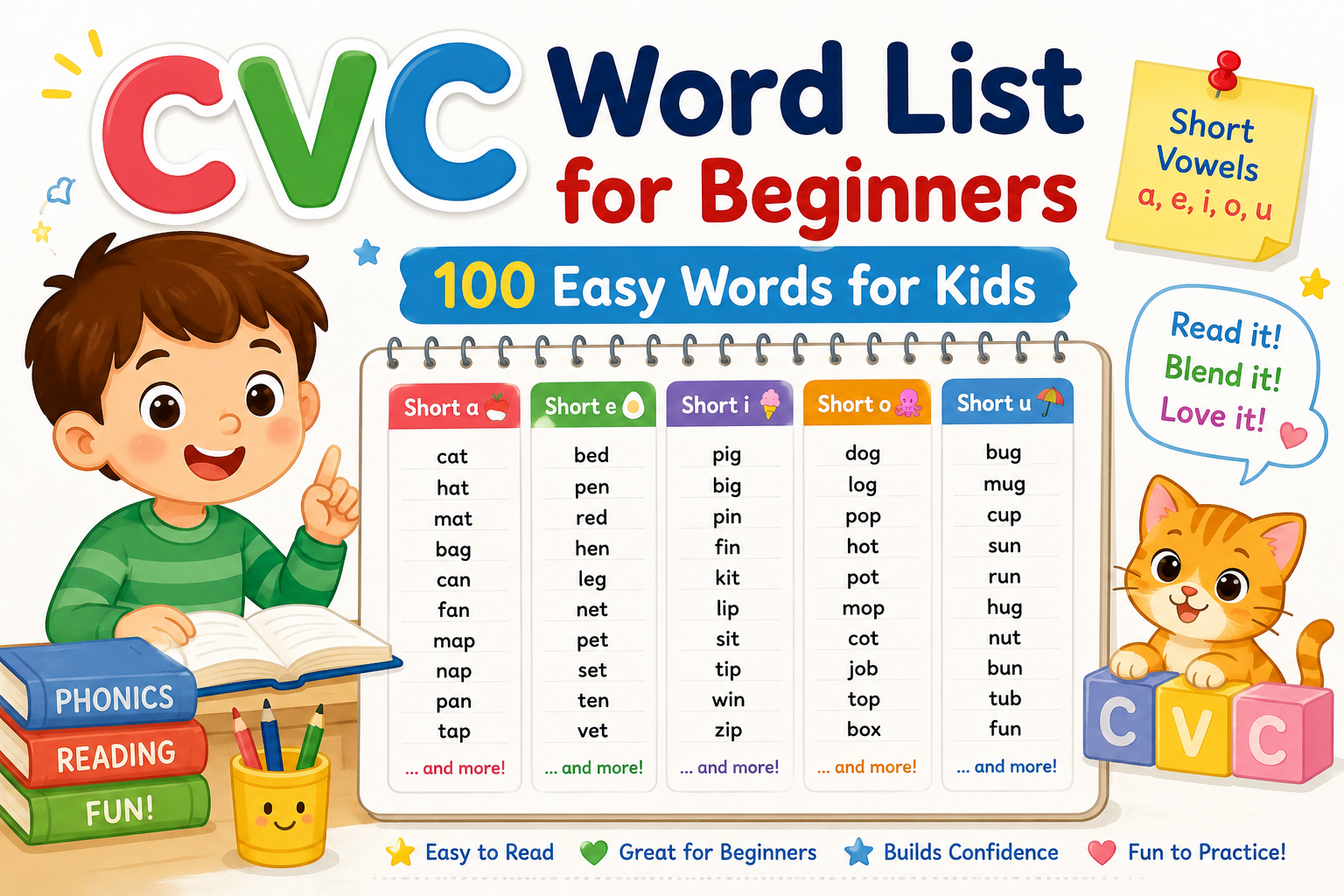
In this guide, you’ll find 100 easy CVC words for beginners, organized by short vowel sounds, along with simple ways to help your child practice reading them at home.
You do not need to teach all 100 words at once.
Start with just a few.
The goal is not to memorize a long word list.
The goal is to help your child discover:
“I can sound this word out by myself.”
100 easy CVC Words for Beginners
Here are 100 beginner – friendly CVC words organized by short vowel sound.
For a child who is just beginning to blend sound, do not use the entire list at once.
Choose about 5 words at a time and practice until reading them begins to feel comfortable.
Short A CVC Words
The short a sound is the vowel sound you hear in cat.
–at words
- Bat
- Cat
- Fat
- Hat
- Mat
- Pat
- Rat
- Sat
-an words
9. Ban
10. Can
11. Fan
12. Man
13. Pan
14. Ran
15. Tan
16. Van
-ap words
17. Cap
18. Gap
19. Lap
20. Map
21. Nap
22. Tap
More short A words
23. Bag
24. Dad
25. Ham
Try blending:
C – a – t → cat
M – a – p → map
F – a – n → fan
Notice how many of these words have the same ending.
Cat – hat – mat – rat
When children recognize the –at pattern, they do not have to approach every new word as if they have never seen anything like it before.
They can use a pattern they already know.
Short E CVC Words
The short e sound is the vowel sound you hear in bed.
-ed words
26. bed
27. Fed
28. Led
29. Red
–en words
30. Den
31. Hen
32. Men
33. Pen
34. Ten
-et words
35. Get
36. Jet
37. Let
38. Net
39. Pet
40. Set
41. Wet
More short E words
42. Beg
43. Hem
44. Leg
45. Peg
Try blending :
B – e – d → bed
P – e – n → pen
N – e – t → net
Try reading these together :
Bed – fed – led – red
Then try :
Jet – net – pet- set – wet
Ask your child :
“What part stays the same?”
This helps children begin noticing word patterns naturally.
Short I CVC Words
The short i sound is the vowel sound you hear in pig.
-ig words
46. Big
47. Dig
48. Fig
49. Pig
50. Rig
51. Wig
-in words
52. Bin
53. Fin
54. Pin
55. Tin
56. Win
-ip words
57. Dip
58. Hip
59. Lip
60. Rip
61. Sip
62. Tip
-it words
63. Bit
64. Fit
65. Hit
66. Kit
67. Sit
Try blending :
P – i – g → pig
F – i – n → fin
S – i – t →sit
Now try changing only the first sound :
Pig → dig → fig → wig
This is a simple way to show children that changing one sound can make a completly different word.
Short O CVC Words
The short o sound is the vowel sound you hear in hot.
-og words
68. Dog
69. Fog
70. Hog
71. Jog
72. Log
-ot words
73. Cot
74. Dot
75. Hot
76. Lot
77. Pot
78. Rot
-op words
79. Cop
80. Hop
81. Mop
82. Pop
83. Top
More short O words
84. Cob
85. Nod
86. Rod
87. Sob
Try blending :
D – o – g → dog
H – o – t → hot
M – o – p → mop
You can turn this into a quick word game.
Start with :
Dog
Change d to f.
What is the new word?
Fog
Then :
Fog → hog →log
Your child is not simplyn memorizing four words.
They are learning how sounds work inside words.
Mistake 1 : Teaching Too Many Words at once
Short U CVC Words
The short u sound is the vowel sound you hear in sun.
-ug words
88. Bug
89. Dug
90. Hug
91. Jug
92. Mug
93. Rug
-un words
94. Bun
95. Fun
96. Run
97. Sun
More short U words
98. Cup
99. Gum
100. Nut
Try blending :
S – u – n → sun
C – u – p → cup
B – u – g → bug
Try reading :
Bug – dug – hug – jug – mug – rug
Once children recognize –ug, they only need to pay close attention to the beginning sound to read each new word.
CVC Word List at a Glance
Here is the complete list grouped by vowel sound.
Short A
Bat, cat, fat, hat, mat, pat, rat, sat, ban, can, man, pan, ran, tan, van, cap, gap, lap, map, nap, tap, bag, dad, ham
Short E
Bed, fed, led, red, den, hen, men, pen, ten, get, jet, let, pet, set, wet, beg, hem, leg, peg
Short I
Big, dig, fig, pig, rig, wig, bin, fin, pin, tin, win, dip, hip, lip, rip, sip, tip, bit, fit, hit, kit, sit
Short O
Dog, fog, hog, jog, log, cot, dot, hot, lot, pot, rot, cop, hop, mop, pop, top, cob, nod, rod, sob
Short U
Bug, dug, hug, jug, mug, rug, bun, fun, run, sun, cup, gum, nut
Save this list and practice just a few words each day.
How to Teach CVC Words to a Beginner
Knowing which words to teach is only half the story.
How you practice them matters, too.
Here is a simple progression you can use at home.
Step 1: Make Sure your Child Knows Basic Letter Sounds
Before asking a child to read map, they need to recognize the sounds:
M
A
P
They do not have to know every letter sound perfectly before beginning CVC words.
But if almost every letter requires a long pause, blending may be too difficult.
In that case, spend a little more time practicing letter sounds short vowel sounds before moving forward.
Step 2: Start With One Short Vowel
Do not mix all five vowels immediately.
Start with one vowel, such as short a.
Try :
cat
hat
mat
map
fan
This allows your child to focus on blending without having to constantly switch between unfamiliar vowel sounds.
Once short A words become easier, introduce another vowel.
Step 3: Stretch the Sounds and Blend Them Together
Let’s use the word:
Map
Point to each letter.
Say:
/m/ – /a/ – /p/
Then bring the sounds closer together.
/m/…/a/…/p/
/m/-/a/-/p/
Map
Some children can say all three individual sounds correctly but still cannot hear the whole word.
That is normal for a beginning reader.
Blending is a skill that develops with practice.
Step 4: Practice Word Families
Once your child can blend a few words, group similar words together.
For example:
Cat
Hat
Mat
Rat
Ask:
“What is the same in all these words?”
The child may begin to notice:
–at
Now change the first letter.
C- at → h – at
Hat
Then:
H – at → m – at
Mat
Word families help children see that words have patterns.
This can make reading new words feel much less intimidating.
Step 5: Mix the Words
There is one important thing to remember about word families.
If children always practice:
Cat, bat, hat, mat, rat
in exactly the same order, they may begin predicting or memorizing the pattern rather than truly reading each word.
So after practicing a word family, mix the words.
Try:
Map
Cat
Fan
Bag
Hat
Now your child has to look at all the letters and blend the sounds carefully.
Step 6: Move From Words to Simple Sentence
When individual CVC words become easier, begin using them in very short sentences.
For example:
A cat sat.
A dog can run.
The pig is big.
The sun is hot.
Do not worry if your child still needs help with word such as the or is.
The purpose is to show them that the words they are learning can be used in real reading.
Teacher’s Tip : Knowing Letter Sound Is Not the Same as Reading
One thing I often notice when teaching beginning English learners is this:
A child may know every letter sound in a word and still be unable to read the word.
Show them:
Cat
They may correctly say:
/k/
/a/
/t/
Then you ask:
“What word is it?”
Silence.
This can be confusing for parents.
“If my child knows all three sounds, why can’t they read the word?”
Because recognizing individual sounds and blending those sounds together are different skills.
The child does not necessarily need more words to memorize.
They need opportunities to practice connecting sounds.
When this happens, try not to give the answer immediately.
Instead, point under each letter and slowly bring the sounds closer together.
/k/…/a/…/t/
Then:
/k/ – /a/ – /t
Give your child a moment to hear it.
Cat!
That moment of figuring out the word independently is much more valuable than simply being told the answer.
5 Simple Ways to Practice CVC Words at Home
You do not need expensive materials or a complicated phonics program to practice CVC words.
Here are five easy activities.
🎁Free work sheet


1. Change One Letter
Start with:
Cat
Ask:
“What happens if we change C to H?”
Hat
Now change H to M.
Mat
Try:
Cat → hat → mat →rat
Or:
Pig → dig →wig
This helps children understand that changing one sound changes the word.
2. Build CVC Words
Use magnetic letters, alphabet blocks, or homemade letter cards.
Say:
“Can you make sun?”
Your child finds:
S + u + n
Then point to each letter and blend:
/s//u//n/ → sun
Building a word physically can be especially helpful for children who enjoy hands on learning.
3. Try a CVC Word Hunt
Write five CVC words on small pieces of paper.
For example:
Cat
Dog
Sun
Pig
Hat
Hide them around the room.
Each time your child finds a card, ask them to sound out the word.
This turns a short reading activity into a game.
4. Match Pictures and Words
Choose familiar words that are easy to illustrate:
Cat
Dog
Pig
Sun
Hat
Show a picture and several written words.
Ask:
“Which word says cat?”
Encourage your child to sound out the choices instead of guessing from the first letter.
5. Make Silly CVC SEntences
Children often enjoy sentences that sound funny.
Try:
A pig can jog.
A cat can hop.
A dog sat on a rug.
Some words in these sentences may not follow a simple CVC pattern, so help with those when necessary.
The goal is to give children a reason to use the CVC words they can decode.
A Simple 10 – Minute CVC Practice Routine
You do not need to practice for an hour.
For beginning readers, short and consistent practice can be much easier to manage.
Try this simple routine.
2 minutes: Review sounds
Review one short vowel and a few consonant sounds.
3 minutes : Blend five words
For example:
Cat
Hat
Map
Fan
Bag
2 minutes : play a word – changing game
Try:
Cat → hat → mat
2 minutes : Reader one simple sentence
For example:
A cat sat.
1 Minute : Finish with an easy success
End with a word your child can read independently.
This last part matters.
Reading practice should not always end with the hardest word.
Sometimes it is better to finish with :
“I did it!”
Common Mistakes When Teaching CVC Words
Mistake 1: Teaching Too Many Words at Once
This article contains 100 words.
That does not mean your child should practice all 100 words this week.
Five words may be enough for the first practice session.
When those become comfortable, add a few more.
Mistake 2 : Turning CVC Words Into Sight Words
If a child sees cat and cannot read it, it can be tempting to say:
“Just remember. This is cat.”
But the purpose of CVC practice is to develop decoding skills.
Encourage the child to use the sounds:
/k//a//t/
Rather than relying only on memorization.
Mistake 3: Adding Extra Sounds to Consonants
When teaching consonant sounds, try to keep them clean and short.
For example, say:
/m/
Rather than :
“Muh”?
Why?
Imagine trying to blend :
Muh – a – puh
It is much harder to hear:
Map
Extra vowel sounds can interfere with blending.
Mistake 4 : Moving too Fast
Your child reads five CVC words successfully.
Should you immediately move on to long vowels and difficult sentences?
Not necessarily.
Children need repeated opportunities to use a skill until it becomes easier and more automatic.
A simple progression might look like :
Letter sounds
⬇️
Short vowel sounds
⬇️
CVC words
⬇️
Word families
⬇️
Mixed CVC practice
⬇️
CVC sentences
⬇️
Blends and digraphs
There is no prize for finishing phonics quickly.
The goal is to build a strong foundation for reading.
Frequently Asked Questions About CVC Words
What age should children learn CVC words?
There is no single perfect age.
Children are usually ready to begin CVC words when they can recognize many basic letter sounds and are beginning to understand that sounds can be blended together to make words.
Readiness matters more than age.
How many CVC words should I teach at once?
For a beginner, start with around 3-5 words.
If your child finds them easy, you can gradually add more.
It is better to read five words successfully than struggle through a list of 30.
Should I teach one vowel at a time?
For many beginners, yes.
Starting with one short vowel can make the pattern easier to understand.
For example:
Cat,hat, mat, fan, map
Later, mix different vowels:
Cat, bed, pig, hot, sun
Mixed practice helps you see whether your child is actually reading the vowel sound rather than guessing from a familiar pattern.
Should children memorize CVC words?
The main goal should be decoding, not memorizing every CVC word.
With repeated reading, children will naturally begin recognizing common words quickly.
But first, they should learn that they can use letter sounds to work out unfamiliar words.
What comes after CVC words?
Once your child can comfortably blend CVC words, you can gradually introduce:
Word families
Simple CVC sentences
Consonant blends
Digraphs
Long vowel patterns
and beginner – friendly decodable reading.
Move forward gradually while continuing to review earlier skills.
What to Learn Next
Learning 100 CVC words is not the real goal.
Learning how to read a new word is.
Start with:
Cat
Then your child discovers:
Hat
Mat
Rat
Soon, instead of asking:
“What does this word say?”
They begin trying:
/r//a//t/…rat!
That change is important.
They are beginning to understand how reading works.
Start small.
Practice five words.
Play with the sounds.
Read them again tomorrow.
And when your child sounds out a new word without your help, give them a moment to enjoy it.
Because every independent:
“I got it!”
is one more step toward becoming a confident reader.
Happy reading!
-Soro English