Why Every Child Should Master Short Vowels Before Moving on
One afternoon, a parent asked me a question that I still remember.
“My child knows the alphabet, understands letter sounds, and has finished a phonics workbook. So why is reading still so difficult?”
When I listened to the child read, I noticed something immediately.
The problem wasn’t confidence.
The problem wasn’t vocabulary.
The child simply wasn’t hearing the short vowel sounds correctly.
That experience reminded me of something I see again and again in my classroom.
Strong readers almost always have strong short vowel skills.
Before children learn long vowels, silent e, or more advanced phonics patterns, they need a solid understanding of the five short vowel sounds.
In my experience, this is one of the most important foundations for learning to read English.
What Are Short Vowel Sounds?
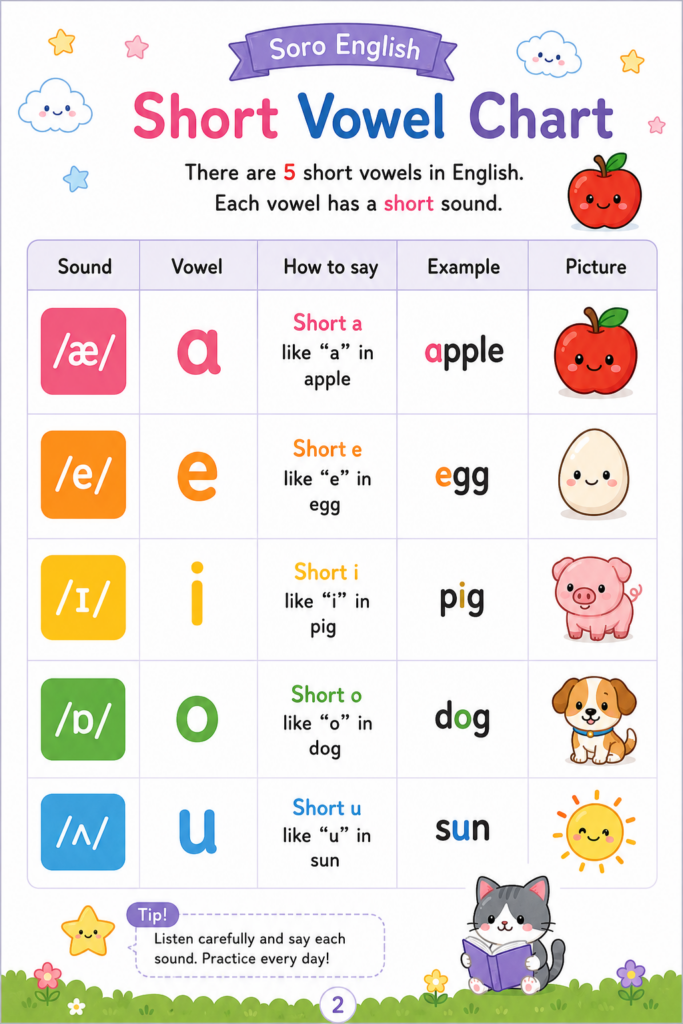
English has five vowels:

A, E, I, O, U
Each vowel can make more than one sound.
The first sounds children usually learn are called short vowel sounds.
Example :
- a → /æ/ → map
- e →/e/ → egg
- i → /ɪ/→ pig
- o → /ɒ/ ( or /ɑ/ in many America accents ) → hot
- u →/ʌ/ → sun
These sounds appear in many of the first words children learn to read.
Why Are Short Vowels So Important?
Imagine trying to build a house without a foundation.
The walls may go up for a while, but sooner or later the house becomes unstable.
Reading works the same way.
Children who don’t recognize short vowel sounds often struggle with simple words like :
- Cat
- Bed
- Pig
- Dog
- Sun
If these words feel difficult, longer words will become even more challenging.
Mastering short vowels gives children the confidence to read independently.
The Five Short Vowel Sounds
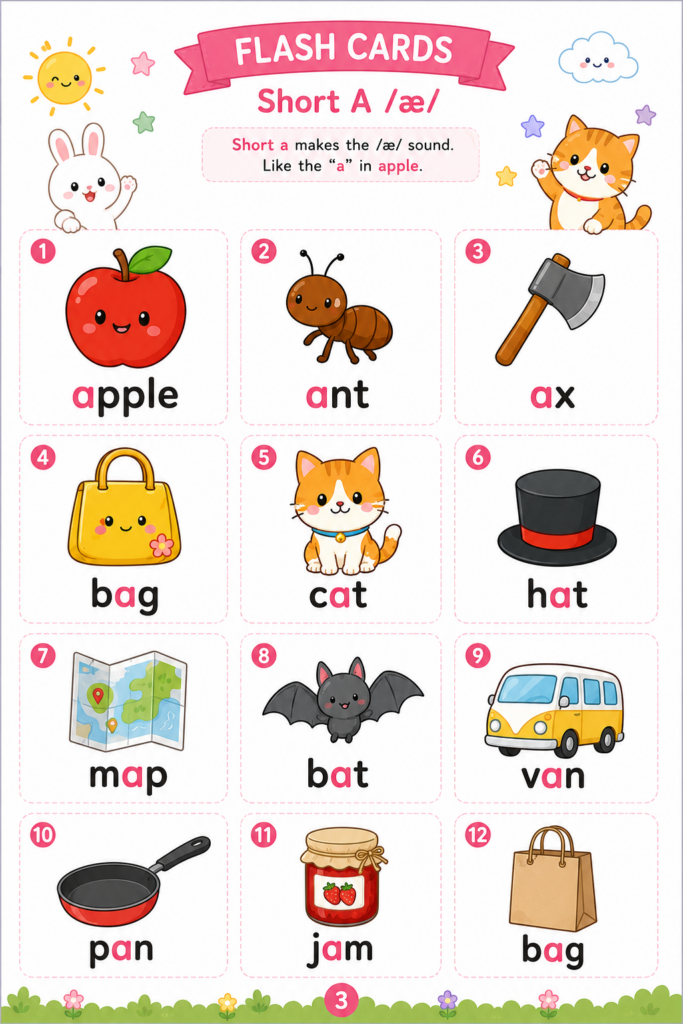
Short A – /æ/
Example word :
- Ant
- Cat
- Map
- Hat
- Mat
Encourage your child to notice the wide mouth shape when saying /æ/.
Short E – /e/
Example words :
- Egg
- Bed
- Pen
- Net
- Red
This sound appears in many early reading books.
Short I – /ɪ/
Example words :
- Pig
- Wig
- Fish
- Sit
- Milk
- Dig
Children sometimes confuse short i with long e, so repeated listening practice is helpful.
Short O – /ɒ/ (or /ɑ/)
Example words :
- Sock
- Dog
- Box
- Fox
- Hot
- Mop
- Dot
Practice saying the sound slowly while looking in a mirror.
Short U – /ʌ/
Example words :
- Sun
- Bus
- Cup
- Duck
- Bun
Many children need extra practice distinguishing u from o.
Common Mistakes Parents Make
Teaching all five vowels at once
Children learn more effectively when they focus on one vowel sound at a time.
Memorizing words without hearing the vowel
Instead of asking,
“What word is this?”
Ask,
“What sound does the middle letter make?”
This encourages children to think like readers.
Moving on too quickly
Children should feel comfortable reading many short vowel words before learning more advanced phonics patterns.
A strong foundation saves time later.
Fun Ways to Practice Short Vowels
Read CVC Words
Example:
- Cat
- Bed
- Pig
- Dog
- Sun
These words give children repeated practice with short vowels.
Sound Sorting
Write several words on cards.
Ask your child to group them by vowel sound.
For example :
Short A :
Cat – hat – map
Short E :
Bed – red – net
Children enjoy turning reading into a simple game.
Read Together Every Day
Even ten minutes of reading can strengthen vowel recognition.
Choose books that match your child’s current reading level.
Success builds confidence.
How Do You Know Your Child Is Ready to move On?
Your child is probably ready for the next phonics step when they can:
✔️ recognize all five short vowel sounds
✔️ read simple CVC words accurately
✔️ blend sounds without guessing
✔️ enjoy reading simple books independently
If these skills are becoming natural, your child is ready to explore more advanced phonics patterns.
Final thoughts
Children often believe that good readers are born with special talent.
As a teacher, I have seen something different.
The strongest readers are usually the children who built their foundations carefully.
Short vowel sounds may seem like a small part of phonics.
In reality, they are one of the biggest building blocks of reading confidence.
Take your time.
Practice often.C
Celebrate every small success.
Because every confident reader begins with one sound at a time.
🔆 Soro English Tip
Don’t ask,
“Can my child finish the phonics book?”
Instead ask,
“Can my child hear the vowel sound in this word?”
Reading begins with listening.
Strong listening leads to confident reading.
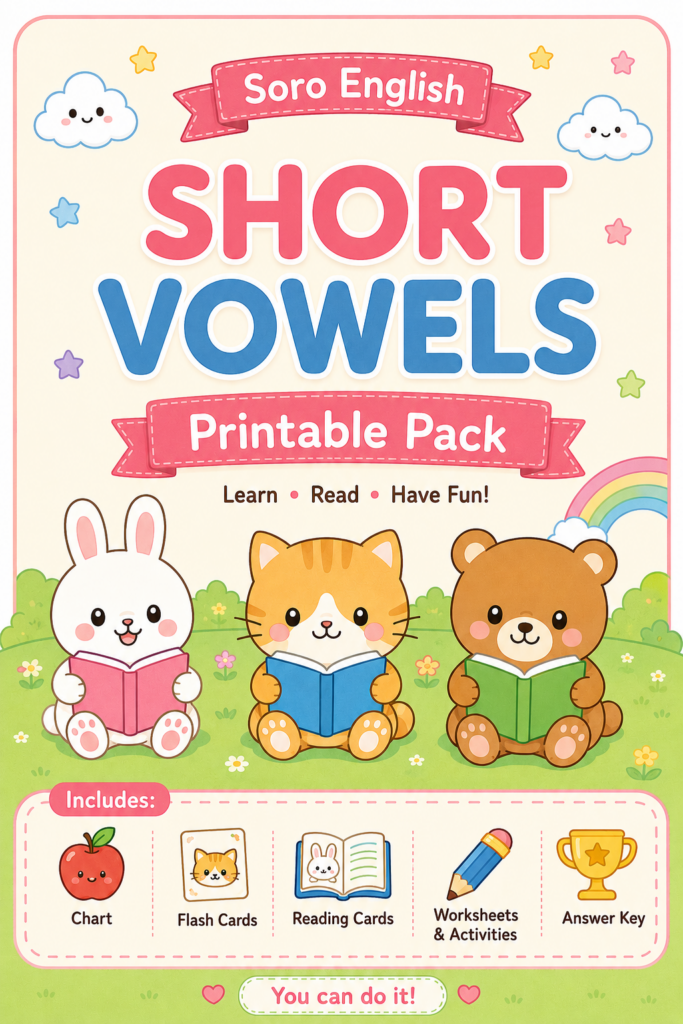
🖍️ Worksheets


© 2026 Soro English
Free for personal, classroom, and homeschool use.
Please do not sell, modify, claim as your own, or redistribute this file.