Your child can read words like cat, pig, dog, and sun.
They’re beginning to recognise word families such as –at, -ig, and –og.
So, what comes next?
For many beginning readers, a natural next step is learning consonant blends.
Words such as stop, frog,clap, flag, and drum may look more difficult than simple CVC words. But once children understand how blends work, these longer words become much more manageable.
In this guide, we’ll look at what consonant blends are, which ones to introduce first, and simple ways to practise them at home or in the classroom.
What is a Consonant Blend?
A consonant blend is a group of two or more consonant that appear next to each other in a word.
The important thing is that you can still hear each sound.
Look at the word:
Stop
At the beginning, we have st.
You can hear both sounds:
/s/ /t/
Now look at:
Frog
The beginning blend is fr.
You can hear:
/f/ /r/
The sounds are close together, but neither one disappears.
That’s what makes them a blend.
Blends vs. Digraphs: What’s the Difference?
This is one of the most common point of confusion for parents teaching phonics at home.
In a blend, you can hear each individual consonant sound.
For example:
St – stop
bl – black
fr – frog
But in a digraph, two letters work together to represent a sound.
Examples include:
sh – ship
ch – chat
th – thin
So:
bl, st, fr = blends
While
Sh, ch, th = digraphs
Children don’t need to memorise these definitions. They simply need plenty of opportunities to hear, blend and read the patterns.
Is My Child Ready for Consonant Blends?
Before introducing blends, it helps if your child can already:
- Recognise most common consonant sounds
- Recognise short vowel sounds
- Blend simple CVC words
- Read words such as cat, hen, pig, dog and sun
- Read a few simple sentences
Your child doesn’t need to read CVC words perfectly.
But if blending three sounds is still very difficult, spend a little longer practising CVC words before adding a fourth sound.
Why Are Blending Harder Than CVC Words?
Compare these two words:
Cat
Clap
To read cat, a child blends three sounds:
/c/ /a/ /t/
To read clap, they need to hold four sounds together:
/c/ /l/ /a/ /p/
That extra consonant may seem small, but it adds another sound for a beginning reader to remember while blending.
This is why it’s helpful to introduce blends gradually rather than teaching a long list all at once.
Start with L – Blends
L-Blends are good group to practise with beginning readers.
Common initial L – blends include:
bl. cl, fl, gl, pl, sl
Let’s look at some easy examples.
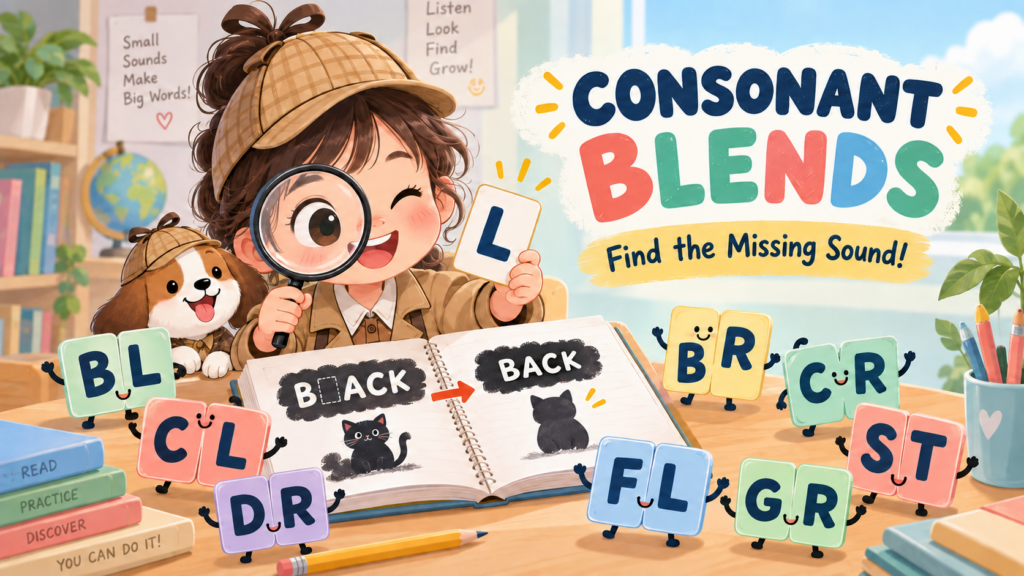
BL Words
Black
Blot
Blip
Say the sounds slowly:
/b/ /l/ /a/ /ck/
Then blend them together.
Black
CL Words
Clap
Clog
Clip
Try:
/c/ /l/ /a/ /p/
–clap
FL Words
Flag
Flat
Flip
Try:
/f/ /l/ /a/ /g/
–flag
GL Words
Glad
Glum
PL Words
Plan
Plop
Plug
SL Words
Slip
Slop
Slug
Don’t worry about teaching every word.
Choose a few words that match the phonics patterns your child already knows.
Move On to R-Blends
Once L-blends feel comfortable, introduce some R-blends.
Common beginning R-blends include:
Br, cr, dr, fr,gr, tr
BR Words
Brag
Brim
CR Words
Crab
Crop
DR Words
Drag
Drip
Drum
FR Words
Frog
From
GR Words
Grab
Grin
TR Words
Trap
Trip
Trim
Again, encourage your child to hear both consonant sounds.
For frog, try:
/f/ /r/ /o/ /g/
Then blend:
Frog
Don’t Forget S – Blends
S – blends are extremely common in early reading.
Useful beginning patterns include:
sk, sl, sm, sn, sp, st, sw
Examples:
Skip
slip
smell
snap
spin
stop
swim
Some S – blend words contain spelling patterns children may not have learnt yet.
That’s fine.
Choose words that fit what your child already knows rather than trying to teach every possible example.
Final Consonant Blends
Blends don’t only appear at the beginning of words.
They can also appear at the end.
For example:
–nd
Hand sand pond
–nt
Ant tent
–mp
Lamp jump
–st
Fast nest
–ft
Left soft
If your child is just stating with blends, I recommend working with initial blends first and introducing final blends gradually.
How to Teach a Blend Step by Step
Let’s use the word clap.
First, point to each letter and say the sounds slowly.
/c/ /l/ /a/ /p/
Then bring the first two sounds closer tegether.
/cl/
Next, blend through the whole word:
/cl/ /a/ /p/
Finally:
Clap
You can slide your finger underneath the letters as your child blends.
This gives children a visual reminder that the sounds need to be joined together.
Avoid Adding an Extra Sound
A common problem when children practise consonants is adding an extra “uh” sound.
For example, instead of:
/b/
a child may say:
“buh”
Then bl can accidentally become something like:
“buh – luh”
which makes blending much harder.
When possible, model a short, clean consonant sound.
For example:
/b/ /l/
rather than:
“buh – luh.”
This small change can make blending much easier.
5 Easy Consonant Blend Activities
You don’t need special equipment to practise blends.
1.Build the Word
Write:
____ + at
Then try different blends:
fl + at = flat
sl + at = slat
Let your child say each sound before reading the complete word.
2.Blend Hunt
Choose one blend, such as st.
Ask your child to find the st words:
Stop
Pig
Step
Sun
Stick
Then read the words together.
3.Sort the Blends
Write a mixture of words on cards.
For example:
flag
frog
clap
crab
flat
grin
Ask your child to sort them:
L – Blends
Flag
Clap
Flat
R- Bledns
Frog
Crab
Grin
4.Read and Draw
Give your child a simple sentence:
The frog can jump.
Ask them to read it and draw what happened.
Another example:
The crab is in the sand.
Reading and drawing is a simple way to check whether your child understands the sentence rather than simply sounding out the words.
5.Silly Sentences
Children often enjoy sentences that sound a little funny.
Try:
The frog can clap.
The crab is on the drum.
The slug can swim.
Ask:
“Can that really happen?”
The silliness gives children another reason to pay attention to what they’re reading.
Try This 10 – Minute Blend Routine
You don’t need a long phonics lesson.
Try this simple routine.
2 Minutes – Review
Read five familiar CVC words.
For Example:
Cat, pig, dog, sun, hen
2 Minutes – Introduce
Choose one blend.
For example:
fl
Say:
/f/ /l/
Then practise joining the sounds:
/fl/
3 Minutes – Read
Try three or four words:
Flag, flat, flip
2 Minutes – Use a Sentence
Read:
The flag is flat.
1 Minute – Review
Ask:
“What blend did we practise today?”
That’s enough.
Tomorrow, you can practise the same blend again before introducing something new.
Should I Teach Every Blend at Once?
No.
There are many consonant blends, and children don’t need to learn them all in one lesson.
A simple progression might look like this:
Step 1 : L – blends
Bl, cl, fl, gl, pl, sl
Step 2 : R – blends
Br, cr, dr, fr,gr, tr
Step 3 : S – blends
Sk, sl, sm, sn, sp, st, sw
Step 4 : Final blends
-nd, -nt, -mp, -st, -ft
The exact order isn’t as important as making sure your child gets enough practice before moving on.
From CVC Words to Blend Words
One helpful teaching strategy is to show children how a familiar word changes when we add another consonant.
For example:
Lip ➡️ slip
Top ➡️ stop
Rip ➡️ trip
Lap ➡️ clap
Rag -➡️ drag
The child already knows much of the word.
Now they’re simply learning to notice the extra sound at the beginning.
This can make longer words feel much less intimidating.
Read Blends in Sentences
Once your child can read several blend words, don’t stay with word lists for too long.
Move into sentences.
Try:
The frog can jump.
The crab is in the sand.
The flag is red.
The slug is on the log.
I can clap.
The drum is big.
Then ask a simple question.
What can the frog do?
Where is the slug?
What colour is the flag?
This keeps comprehension connected to phonics practice.
What If My Child Misses One Sound?
Suppose the word is:
Stop
And your child reads:
Top
They’ve dropped the /s/ sound.
Rather than simply saying, “That’s Wrong,” point to the beginning of the word.
Ask:
“What sound comes before /t/?”
Then blend again:
/s/ /t/ /o/ /p/ ➡️ stop
This helps your child understand what they missed and gives them a strategy they can use next time.
Don’t Rush Into Long Words
Once children start learning blends, it’s tempting to introduce increasingly complicated words.
But beginning readers still need lots of successful practice.
Words such as:
Clap
Flag
Frog
Drum
Stop
are enough to begin with.
Confidence grows when children repeatedly experience:
“I can read this.”
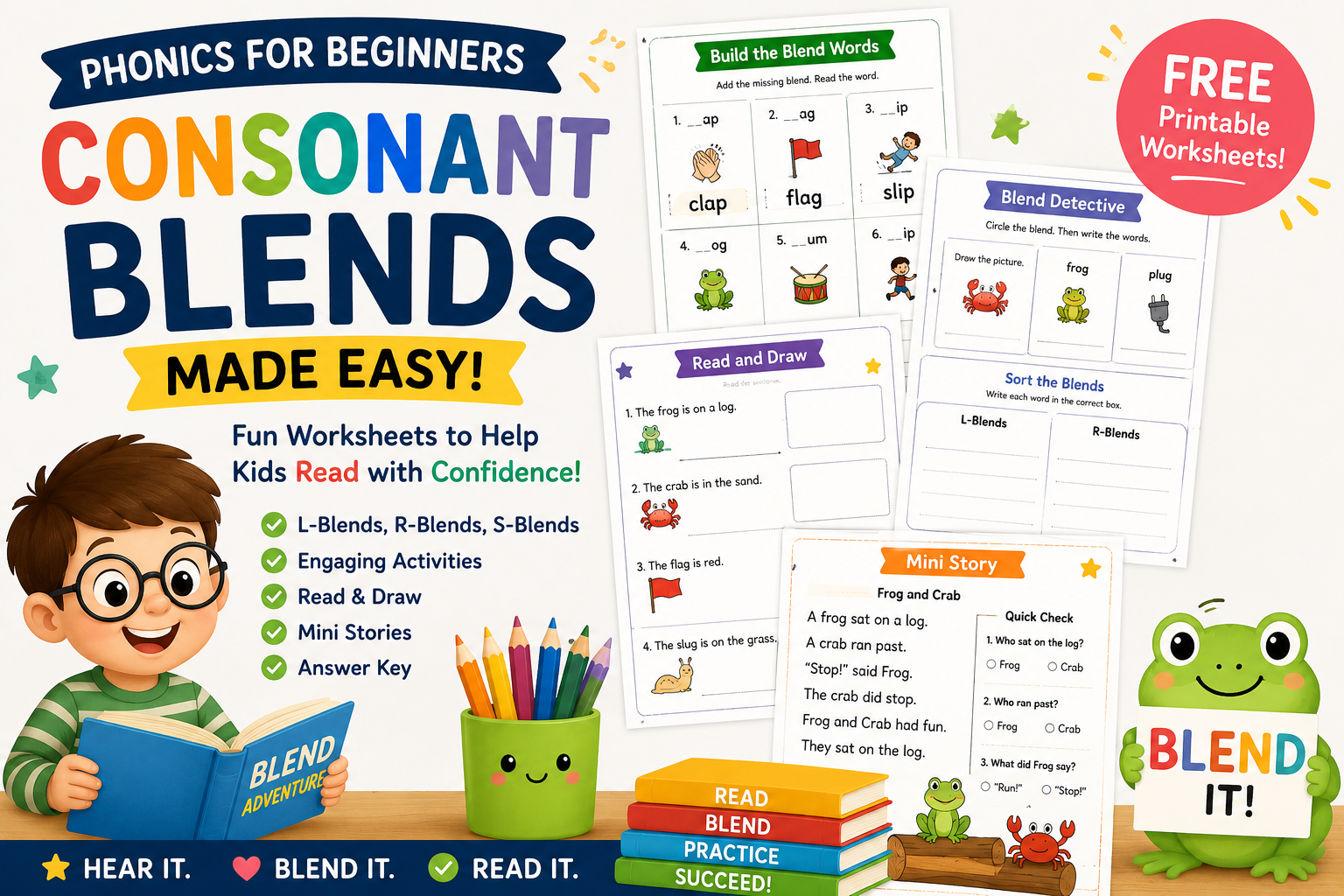
Free Printable Consonant Blend Worksheets
Want some extra practice?
Use the worksheets for short practice sessions at home, in the classroom or during homeschool lessons.
Frequently Asked Questions
What consonant blends should I teach first?
There isn’t one required sequence, but simple initial L – blends such as bl, cl, fl and pl can be a manageable place to begin.
Move gradually into R – blends and S – blends as your child becomes more confident.
What’s the difference between a blend and a digraph?
In a consonant blend, you can hear the individual consonant sounds.
For example:
/f/ /r/ in frog
In a digraph, two letters work together to represent a sound, such as sh in ship.
Should children memorise blend words?
No.
Encourage children to look at the letters and blend the sounds rather than memorising long lists of words.
Repeated reading will naturally make familiar words faster to recognise.
What if consonant blends are too difficult?
Go back to simple CVC words for a little while.
Practise blending three sounds confidently before asking your child to blend four or more sounds.
There’s no need to rush.
What Comes After Consonant Blends?
Once your child is comfortable with common consonant blends, a great next step is learning consonant digraphs.
These include:
Sh
Ch
Th
Wh
Ck
Unlike blends, where we can hear each consonant, digraphs introduce children to letters working together in a different way.
We’ll explore those in the next lesson.
Final Thoughts
Learning consonant blends is an important step between simple CVC reading and more complex phonics.
At first, works like frog, clap, stop and drum may feel much harder than cat or pig.
That’s normal.
Start with one blend.
Say the sounds clearly.
Blend them together.
Read a few words.
Then put those words into sentences.
Small steps add up.
Before long, your child will realise that those “big” four- letter words aren’t quite so scary after all.
Happy reading!
-Soro English