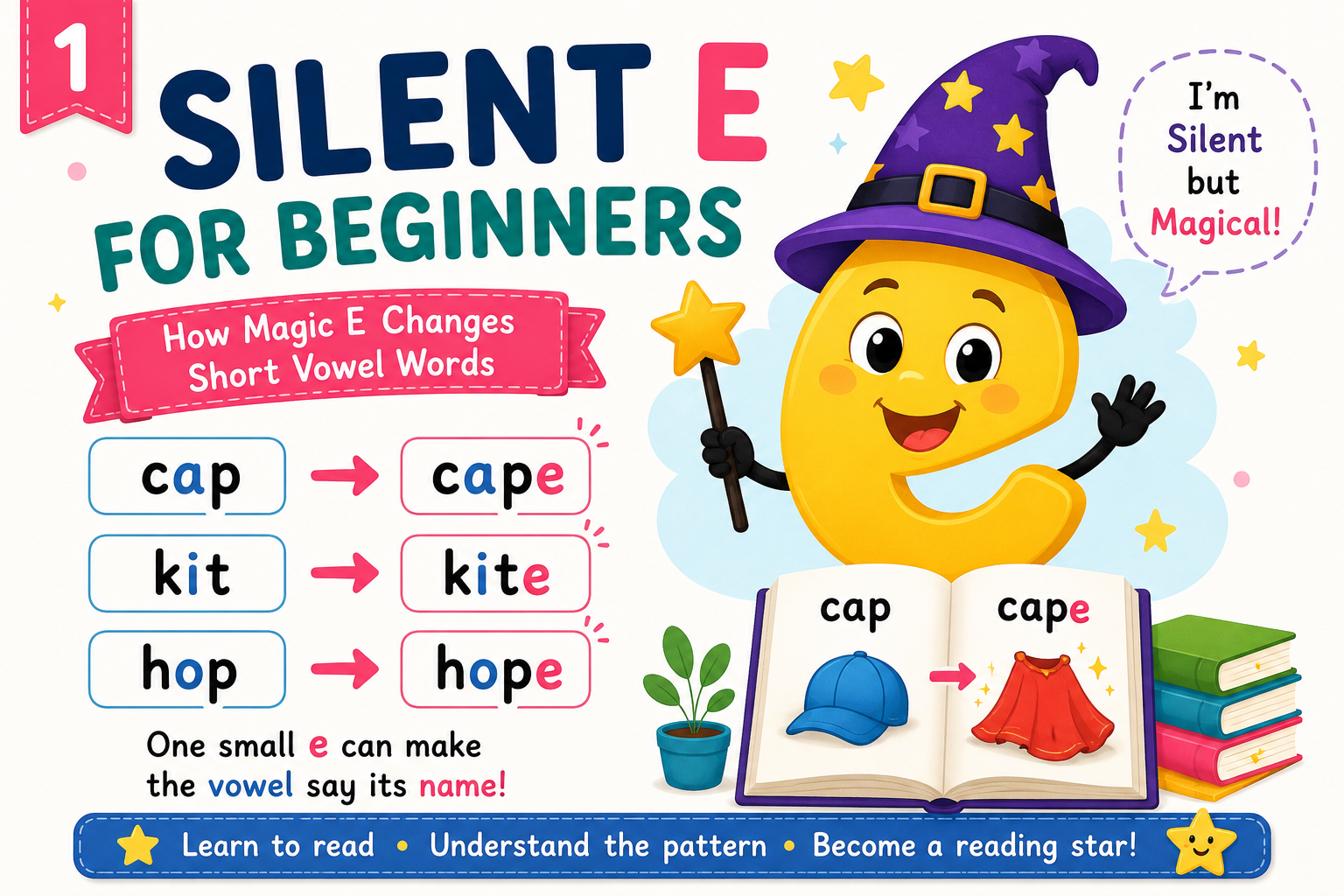
cap ➡️ cape
kit ➡️ kite
hop ➡️ hope
Have you ever shown your child two words like these and watched them stop and stare?
They know cap.
Then they see cape.
there’s only one extra letter, but suddenly the vowel sounds different.
For a beginnig reader, that can feel confusing.
I see this as one of those lovely moments in phonics when children begin to realise that letters don’t work alone. What comes later in word can change what they hear earlier in the word.
And that’s where silent e comes in.
You may also hear it called magic e or fianl e.
whatever name you use, the idea can be introduced quite simply.
Instead of giving children a long list of rules to memorise, I like to put two words next to each other.
cap ➡️ cape
Then we read them.
We listen.
We compare.
And we let the child disconer what changed.
Let’s take it one step at a time.
What Is Silent E?

Look at these two words :
cap
cape
In cap, the letter a has its short vowel sound.
Add an e :
cape
The final e isn’t pronounced as a separete styllable, but the vowel sounnd has changed.
Now compare :
kit ➡️ kite
hop ➡️ hope
cub ➡️ cube
This is one common long – vowel spelling pattern beginning readers learn.
You may have heard the phrase :
“Magic e makes the vowel say its name.”
That can be a useful memory aid for children.
But I wouldn’t stop there.
Children still need to see the pattern in real words, read those words and compare them.
Is My Child Ready for Silent E?
Before I introduce silent-e words, I like children to be fairly comfortable with short vowels.
For example:
a – cat
e – hen
i – pig
o – dog
u – sun
It also helps if they can blend simple CVC words independently.
Try :
cap
kit
hop
cub
if those words are still very difficult, I wouldn’t rush into silent e.
There’s nothing wrong with spending more time on short vowels.
A strong foundation makes the next step easier.
Start With Word Pairs
This is my favourite way to introduce the pattern.
Don’t begin with 20 silent-e words.
Begin with two.
Write :
cap ➡️ cape
Ask your child to read cap first.
Then add e.
Read :
cape
Ask :
“What changed?”
Give them a moment.
Children often notice the extra e first.
Then read both words again :
cap
cape
Now they can hear that something else changed too.
The vowel.
That little discovery is much more memorable than simply telling a child a rule.
Short A ➡️ Long A
Start with a few clear pairs.
cap ➡️ cape
tap ➡️ tape
mad ➡️made
can ➡️ cane
Read them slowly.
Then mix them up :
cape
mad
tape
cap
Now your child has to look at the whole rather than simply following a predictable list.
Short I ➡️ Long I
Next try :
kit ➡️ kite
rid ➡️ ride
fin ➡️ fine
pin ➡️ pine
I like this set because the difference is easy to hear.
Ask :
“Which word has silent e?”
Then:
“How did the vowel sound change?”
You don’t need a long explanation.
Let the words do most of the teaching.
Short O ➡️ Long O
Try :
hop ➡️ hope
not ➡️ note
rod ➡️ rode
cop ➡️ cope
Read each pair.
Then put one word into a sentence.
I hope I can go.
or
The note is on the desk.
The goal is to move away from isolated word lists as soon as the child is ready.
What About U_E Words?
Silent-e patterns with u can be a little more interesting because pronunciation varies across words and accents.
Beginning examples might include:
cub ➡️ cube
tub ➡️ tube
cut ➡️ cute
For children learning English internationally, this is also a good reminder that American and British pronunciation won’t always sound identical.
That’s okay.
We don’t need children to sound exactly like one particular accent.
We want them to recognise the spelling pattern and connect it with the pronunciation they are learning and hearing.
What About E_E ?
You may see words with e_e pattern too, but there are fewer simple beginner – friendly examples than with a_e, i_e and o_e.
That’s why I don’t feel the need to force every vowel into one lesson just to make a chart look complete.
When I’m teaching a beginning reader, I’d rather start with patterns that are easy to see and hear.
We can add the less common patterns later.
Try the “Add an E” Game
This takes almost no preparation.
Write :
Cap
Ask your child to read it.
Then give them an e card.
Let them add it :
Cap + e = cape
Try again :
Kit + e = kite
Hop + e = hope
You can make it feel like a tiny word experiment.
Ask :
“What will happen if we add e?”
Let your child predict the new word before reading it.
Children love discovering that they can change a word themselves.
Be a Word Magician 🪄

If your child enjoys pretend play, make silent e into a little game.
Say :
“Today you’re the Word Magician.”
Give them :
tap
Then say :
“Add your magic e!”
Now :
tape
Try :
Pin – pine
Hop – hope
Cub – cube
After a few rounds, switch roles.
Let your child give you a word.
Make a mistake on purpose occasionally.
Children usually love correcting adults.
And correcting you means they’re paying attention to the spelling.
Don’t Let “Magic E” Become Guessing
The phrase magic e is fun, but I still want children looking carefully at the letters.
I don’t want them to see any word ending in e and automatically assume the same rule will always work.
English has plenty of words that don’t behave exactly as a beginner rule might suggest.
For example :
have
give
love
These are common words, but they don’t follow the simple pattern children might expect from cape, kite or hope.
So I tell children something like :
“This pattern helps us read lots of words, but English sometimes surprise us.”
That’s enough.
We don’t need to turn an early phonics lesson into a lesson about every exception in English.
Short Vowel or Silent E ?
Once your child understands the basic idea, mix the words.
Try :
cap
Cape
Kit
Kite
Hop
Hope
Cub
Cube
Ask your child to sort them into two groups:
Short Vowel Words
Cap
Kit
Hop
Cub
Silent E Words
Cape
Kite
Hope
Cube
Then read all eight words again.
This checks whether your child can recognise the pattern without relying on the order of a word list.

A Simple 10 – Minute silent E Lesson
You don’t need a long lesson.
Here’s a routine I like.
2 Minutes – Review
Read four short-vowel words:
Cap, kit, hop, cub
2 Minutes – Discover
Add e to one word.
Cap – cape
2 Minutes – Compare
Read three word pairs.
Cap / cape
kit / kite
Hop / hope
2 Minutes – play
Play Word Magician or sort-vowel and silent-e words.
2 Minutes – Read
Finish with a short sentence.
The kite is big.
Or
I hope I can ride.
Then stop.
A child doesn’t need to master silent e in one sitting.
What If My Child Keeps Forgetting the E?
Suppose your child sees:
Kite
But reads :
Kit
Instead of immediately saying the word for them, point to the end.
Ask:
“Is there another letter we haven’t looked at yet?”
Let them notice the e.
Then compare:
Kit
Kite
And read both.
I prefer this to simply saying:
“Remember, magic e!”
Because I’m trying to help the child develop a strategy they can use independently.
Look all the way through the word.
Read Silent E Words in Sentences
Once individual words are becoming easier, move into sentences.
Try:
The kite is red.
I can ride a bike.
I hope the dog is fine.
The cube is big.
Dad made a cake.
Don’t worry if every word in a sentence doesn’t follow the target pattern.
Help with unfamiliar words when needed and keep the child’s attention on the silent-e words you’re practising.
From Sentences to a Mini Story
When a child can read individual silent-e words, I like to move quickly towards connected reading.
Here’s a simple example.
Jake’s Kite
Jake has a kite.
The kite is red.
Jake can ride his bike.
He takes the kite with him.
Jake likes his kite.
After reading, ask:
What does Jake have?
What colour is the kite?
What can Jake ride?
Now the child is doing more than recognising a spelling pattern.
They’re reading to understand.
That’s always where I want phonics practice to lead.
Try a Silent E Word Hunt
Give your child a mixture of words:
cap
kite
dog
hope
pin
cape
sun
cube
Ask:
“Can you find all the silent-e words?”
Then let them circle:
kite
hope
cape
cube
Next, read the words together.
You can turn almost any phonics activity into a detective game with one sentence:
“Can you find them all?”
Read and Draw
This is another activity I use because it combines decoding with comprehension.
Give your child :
The kit is red.
Ask them to draw it.
Then:
The cube is on the mat.
Draw it.
If the picture matches the sentence, you get a quick glimpse of whether the child understood what they read.
And to a child, it feels much less like a test.
What If My Child Can Read the Word but Doesn’t Understand it?
This happens more often than we sometimes realise.
A child may successfully decode a word without knowing what it means.
If they read:
Cube
Ask:
“Do you know what a cube is?”
If not, explain it, show an object or draw one.
Phonics helps children access words.
Vocabulary helps those words mean something.
We need both.
Don’t Rush to the Next Phonics Pattern
It’s tempting to keep moving.
Short vowels.
CVC words.
Blends.
Digraphs.
Silent e.
Vowel teams.
But reading isn’t a race through a phonics checklist.
If your child needs another week with silent e, take another week.
Read the same words in new sentences.
Play another game.
Reread a familiar story.
Confidence and automaticity come from successful repetition.
Frequently Asked Questions
What is silent e?
Silent e is a common spelling pattern in which a final e isn pronounced as a separate syllable but can affect the preceding vowel, as in cap/cape and kit/kite.
Is silent e the same as magic e?
Magic e is a child-friendly teaching name commonly used for the pattern. You may also see terms such as silent e and final e.
What silent-e words should I teach first?
Start with clear, easy-to-compare pairs such as cap/cape, kit/kite and hop/hope. A few carefully chosen examples are more useful than a huge list at the beginning.
Why doesn’t the rule work in words like “have”?
English spelling contains words that don’t follow the simple beginner pattern. Teach the common pattern first and introduce exceptions gradually as children encounter them.
Should I teach all five vowels at once?
Yon don’t have to. Starting clear a_e, i_e and o_e examples and adding other patterns gradually can make the concept easier to understand.
What comes after silent e?
Once children are comfortable with common silent-e patterns, you can begin exploring other long-vowel spellings, including vowel teams such as ai, ay, ee, ea, oa and ow.
What Should We Learn Next?
If your child can now read.
Cap- cape
kit – kite
Hop – hope
They’ve made another important step.
But here’s something children soon discover:
Long vowel sounds aren’t only made with silent e.
English also has words such as:
Rain
Play
Feet
Team
Boat
That’s where vowel teams come in.
In our next lesson, we’ll look at:
Vowel Teams for Beginners: How to Teach AI, AY, EE, EA, OA and OW
We’ll compare the patterns, practise them in words and learn how to help children when two spellings can represent similar vowel sounds.
Final Thoughts
Silent e can look like another phonics rule children have to memorise.
I prefer to make it something they can
Start with:
cap
Add one letter:
Cape
Read both.
Listen.
Compare.
Then let your child try another.
When children begin noticing patterns for themselves, reading starts to feel less like remembering hundreds of separate words and more like solving a puzzle.
And that’s one of my favourite moments when teaching a beginning reader:
when a child looks at a word they haven’t read before, pause for a second and then works it out.
Not because someone told them the answer.
Because they knew what to try.
Happy reading!
-Soro English